Table of Contents
The company profile stands as a cornerstone of corporate communication, serving as a critical business document that concisely presents an organization’s identity, vision, values, products, and services in a compelling manner. A well-written company profile is tasked with engaging a wide range of strategic audiences, including potential customers, partners, investors, job seekers, employees, and industry peers. Its ability to clearly communicate core values and build trust ultimately enhances how people perceive the company.
Traditionally, crafting such a document demanded significant time and resources from writers, designers, and marketing professionals. However, the advent of generative artificial intelligence (GenAI) has fundamentally shifted this process, transforming content creation from a manual drafting procedure into a sophisticated workflow optimization strategy centered on data curation, prompt architecture, and meticulous verification. This article details a structured framework for leveraging AI to generate a high-quality, professional company profile, covering essential components, advanced prompting techniques, risk mitigation strategies, and the required human oversight necessary to ensure factual accuracy and brand consistency.
I. The Strategic Imperative and Core Components of the Profile
A company profile functions as more than a simple document; it acts as a powerful marketing tool, a key driver of credibility, a reflection of brand identity, and a resource for recruitment and investment information. Customers who visit a company’s “About Us” page often spend 22.5% more than those who do not, and 52% of people report wanting to see the “About Us” page first when landing on a website. Furthermore, research confirms that 58% of customers and 60% of job candidates base their decisions on a brand’s shared beliefs and values, underscoring the need for authenticity and clarity in the profile.
To meet these high-stakes requirements, a company profile must adhere to a detailed and comprehensive anatomy, explicitly mapped out for AI generation:
A. Core Business Elements
The foundational information creates the base layer of trust and context for all subsequent details.
- Basic Company Information: These concrete details—such as the founding date, key executives, company location, and number of employees—are foundational for building trust. Failure to include these basic facts can erode confidence in the company’s products or services.
- Mission and Vision: This section conveys the business philosophy and corporate culture, helping to establish a clear identity in the reader’s mind. The mission clearly expresses the company’s purpose, values, and social impact, while the vision describes long-term goals and the impact the company hopes to make. For instance, a mission might be guided by core values like Innovation, Excellence, and Responsibility, aiming for technological advancement and sustainable public good.
- Products and Services: The profile must briefly describe the offerings, emphasizing what specifically sets the company apart to spark interest. This should explain how the services or products solve problems, meet needs, and detail their features, functionality, and competitive advantages.
B. Culture and Credibility Elements
Beyond mere data, the profile must build a relatable image and demonstrate verifiable success.
- Company History: Showcasing the company’s milestones helps readers understand the roots and evolution of its values, giving the brand a more concrete and relatable image. Writing tips suggest explaining when and why the company was established and highlighting major achievements like strategic partnerships or market expansions that showcase growth.
- Success Stories and Case Studies: Specific achievements, awards, or accomplishments are powerful tools for demonstrating why the company stands out and why others should choose its services. For example, a company history might highlight receiving international recognition like an Innovation in Technology Award and a User Experience Excellence Award.
- Company Values and Culture: Sharing the ethical approach and work culture helps shape a connection with like-minded partners, clients, and employees.
II. Leveraging AI for Efficiency and Scale
The integration of GenAI offers strategic advantages that redefine the content production process, primarily by reducing the effort required for initial drafts of official documents by an estimated 50–70%.
A. Benefits of AI in Content Generation
AI writing tools accelerate content creation dramatically. An AI content generator can produce a coherent draft quickly, often taking minutes for content that might take a human writer several hours.
- Speed and Efficiency: AI enables unprecedented scalability by rapidly drafting content. This capability allows businesses to target hundreds of keywords or fill out an entire knowledge base quickly. For instance, AI-generated profiles are typically based on extensive training data, offering a wide variety of structured, well-worded templates.
- Professional Drafting and Translation: AI can produce a complete and well-structured profile quickly simply by inputting the business information into an AI Company Profile Generator. Furthermore, if an English version is needed, AI translation tools can quickly convert the content, making it one of the fastest ways to create a multi-language profile.
- Design Assistance and Data Analysis: AI can analyze company data (like financials, customer reviews, or market trends) to provide insights for the profile. AI-driven design tools can also recommend layouts, font schemes, and generate visual elements like charts and graphs, ensuring design consistency.
B. Shifting Professional Roles
AI adoption requires professionals to transition from primary writers to “high-level content architects” who focus on prompt architecture and data integrity. The speed of AI accelerates content creation, freeing up human staff to focus on strategic tasks like fact-checking, strategic refinement, and ensuring the content aligns with the company’s unique identity and values.
III. Architecting Accuracy: Mastering Prompt Engineering
The quality and competitive advantage of an AI-generated corporate profile are intrinsically tied to the structure of the instructions provided to the large language model (LLM). Effective prompting, often called prompt engineering, is the skillful art of crafting precise commands to get the desired output.
A. The Structured Prompt Framework (R-C-T-C-E)
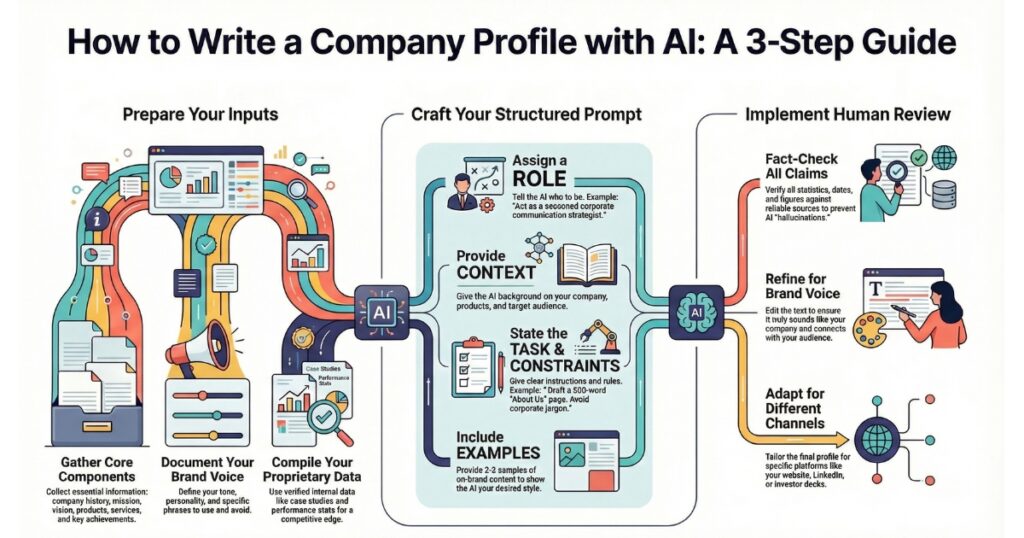
High-stakes corporate communication requires a systematic approach beyond vague requests, leveraging a framework such as Role, Context, Task, Constraints, and Examples (R-C-T-C-E).
- Role (The Persona): This defines the required expertise and tone the AI should embody. Specifying a role, such as “Act as a seasoned corporate communication strategist with 15 years experience drafting Fortune 500 annual reports,” immediately sets a high professional standard and tone.
- Context (The Background): This is the essential layer where proprietary data and brand directives are inserted. It provides background details on the brand name, target audience, core differentiators, product features, and company mission, grounding the AI’s response in the desired reality.
- Task (The Objective): This must clearly outline the specific goals. For complex documents like a company profile, this involves breaking the objective down into a logical progression of smaller, detailed tasks (a “chain-of-thought” methodology).
- Constraints (The Rules): These are non-negotiable boundaries, acting as the prompt’s governance layer. Constraints specify required length limits, mandatory inclusion of specific keywords, and, crucially, the exact parameters of the documented Brand Voice.
- Examples (The Model): Providing few-shot examples (snippets of desired output quality or style) helps the AI calibrate its response. Examples act as a practical guide, illustrating the required format and tonality.
B. The Competitive Edge: Proprietary Data and RAG
Reliance on general LLMs for official corporate profiles introduces unacceptable risk due to the possibility of factual errors (“hallucinations”) and competitive similarity.
- Proprietary Data: This sensitive, non-public information—including technical specifications, validated financial data, compliance requirements, and precise USPs—is the bedrock of a factually verifiable profile and the one thing competitors lack access to.
- Retrieval-Augmented Generation (RAG): The technical solution is RAG, which securely links the LLM to the organization’s proprietary database (e.g., audited reports, internal documentation). When prompted, the LLM uses RAG to pull verified internal facts, dramatically reducing errors, enhancing accuracy, and ensuring the output is grounded in specific business context.
- Data Hygiene: The quality of the output is directly governed by the input data (“garbage in, garbage out”). Therefore, a pre-AI data hygiene audit is mandatory, ensuring foundational facts are rigorously validated and organized before complex RAG integrations or prompting commence.
IV. The Human-AI Partnership: Verification and Consistency
The core challenge of using AI is that its primary benefit (speed) creates its primary risk (lack of rigor), requiring mandatory human involvement to mitigate errors and maintain brand integrity.
A. The Human-in-the-Loop (HITL) Workflow
For corporate profiles, a Human-in-the-Loop (HITL) verification system is essential: AI generates $\rightarrow$ Human reviews/edits $\rightarrow$ Approve. This review process focuses human expertise where it is most needed: critical analysis, fact verification, and subjective refinement.
- Verification and Fact-Checking: Human review is essential to ensure accuracy and relevance. AI can generate plausible-sounding but incorrect details (hallucinations), so all objective claims—statistics, dates, financial figures, and legal statements—must be independently verified against primary, reliable sources.
- Refinement and Personalization: AI content may lack uniqueness or brand voice, so human review is needed to make manual adjustments that better reflect the company’s identity and values. Reviewers refine subjective elements like tone, story flow, examples, and analogies to ensure brand fit. This ensures the final output feels authentically human rather than generic.
B. Documenting and Enforcing Brand Consistency
Brand consistency is a major component of trust, but generic AI tools optimize for “professional,” leading to forgettable, off-brand language that can destroy years of brand building if not carefully guarded.
- Comprehensive Documentation: Effective brand voice documentation must move beyond vague descriptors like “professional and friendly”. Guidelines must specify Voice Characteristics (tone, language level, perspective, personality traits) and Specific Do’s and Don’ts (mandatory terminology, jargon to avoid, favored metaphors).
- AI Training and Learning Loops: AI must be trained on the company’s actual brand by feeding it 10–20 samples of the best existing, high-performing content that perfectly captures the established voice. Crucially, systems must have learning loops to track human edits and feed those patterns back to the AI, ensuring the model improves its brand alignment over time rather than making the same mistakes repeatedly.
- Continuous Calibration: Periodic, structured Calibration Sessions must be held where teams review AI output against brand alignment criteria to ensure the guidelines remain current and the team is aligned on what “sounds like us” means.
V. Governance, Ethical Requirements, and Multi-Channel Deployment
The strategic use of AI in generating official corporate content requires adherence to strict governance standards, focusing on legal compliance, ethical risk mitigation, and channel-specific adaptation.
A. Ethical and Legal Obligations
Ethical requirements for GenAI in brand content creation often revolve around eight key conditions, with Intellectual Property being particularly critical for protecting brand reputation.
- Intellectual Property (IP): IP rights must be honored to avoid legal issues, as AI-generated works may reproduce copyrighted material if trained on scraped data. Content marketers must avoid prompts that replicate known copyrighted material or impersonate specific brand voices without licensing.
- Transparency: Transparency about AI usage builds trust and ensures accountability. Disclosing AI involvement, perhaps through disclaimers or visual indicators, reflects a moral obligation to inform consumers and prevent deceptive practices.
- Accuracy and Bias: Corporations must mitigate biases present in the training data, which can lead to discriminatory or misleading outputs. Systematic testing of AI-generated content across demographics and fact-checking against reliable sources is mandatory.
- Privacy and Security: Strict data privacy standards must be maintained, especially when dealing with proprietary data fed to RAG systems. Companies must use platforms with strong privacy measures and avoid inputting sensitive customer data into external AI tools.
B. Tailoring the Profile for Multi-Channel Deployment
A successful master company profile must be adapted to fit the specific audience, intent, and formatting constraints of different channels.
- For Clients and Customers: The content should focus on how the products or services solve their problems, emphasizing case studies, testimonials, and practical benefits.
- For Investors: The profile must focus on financial projections, market positioning, competitive advantage, and future growth potential, often requiring structured analytical frameworks like SWOT analyses. The prompt must instruct the AI to generate high-level summaries of financials and capabilities formatted for presentation slides.
- For Job Seekers: Prospective employees prioritize company culture, values, and career development opportunities; thus, the profile should highlight the work environment and employee benefits.
- Website (“About Us”): This primary channel demands a focus on Storytelling and Values to establish a human connection. The content must use simple, sensible language, detailing the origin story, mission, vision, and core values, and must be optimized for usability (short paragraphs, clear headers).
- LinkedIn Company Page: This platform demands concise, keyword-rich content optimized for visibility. The profile summary should be brief, and the content must focus on quickly establishing credibility.
VI. Conclusion: AI as a Strategic Asset
Creating a company profile using AI is a strategic exercise that prioritizes disciplined adherence to a structured framework over relying on mere speed. The analysis confirms that a genuine competitive edge is achieved through the secure integration of proprietary data via RAG architecture, transforming the AI from a general word generator into an authoritative, fact-checking content engine.
The successful implementation of this strategy hinges on the mandatory institutionalization of the five-part R-C-T-C-E structured prompt architecture. This system acts as the definitive control mechanism, ensuring that content adheres to specific constraints regarding brand voice, factual sources, and required technical formatting.
Ultimately, while AI provides substantial time savings—allowing initial drafts to be completed 50–70% faster—the expertise of the human content architect remains non-negotiable. The human role is critical for validating objective claims against proprietary sources and refining the narrative to maintain brand authenticity. By embracing this disciplined human-AI collaboration, organizations can scale their communications effectively and ensure their company profile remains an accurate, trustworthy, and differentiated representation of their brand across all channels. This approach ensures that the content is not only fast and comprehensive but also maintains the ethical rigor and quality necessary to build stakeholder trust and drive business growth.
For more articles, click here.