
Table of Contents
Introduction: The New Frontier of Corporate Strategy
The modern enterprise operates in an environment of unprecedented complexity. Organizations now generate vast quantities of data daily—structured transactions, unstructured customer interactions, sensor readings from IoT devices, social media sentiment, and countless other digital traces of business activity. This deluge of information has fundamentally transformed how companies formulate strategies, allocate resources, and engage with stakeholders. The pervasive adoption of data-driven technologies, particularly artificial intelligence, has enabled organizations to extract insights at speeds and scales previously unimaginable, automating processes that once required extensive human intervention and predicting outcomes that would have been purely speculative just a decade ago.
Yet this transformation brings profound challenges alongside its opportunities. As decision-making increasingly relies on algorithmic logic rather than human intuition alone, critical questions emerge about accountability, transparency, and fairness. Who is responsible when an AI system makes a flawed recommendation that costs millions? How do we ensure that predictive models don’t perpetuate historical biases embedded in training data? What governance structures are needed to maintain data integrity across complex, distributed systems?
For decades, Business Intelligence tools have served as the analytical backbone of organizations, providing dashboards and reports that help leaders visualize trends, diagnose problems, and understand what happened in the past. These retrospective insights remain valuable, but they’re no longer sufficient in industries where competitive advantage depends on anticipating change rather than merely reacting to it. The finance sector must predict market movements before they occur. Defense organizations need to identify threats before they materialize. Cybersecurity teams must detect anomalies in real-time to prevent breaches.
This imperative has catalyzed the emergence of Decision Intelligence—a discipline that represents the next evolution beyond traditional analytics. Decision Intelligence shifts the focus from explaining the past to shaping the future, integrating artificial intelligence, machine learning, and human expertise to connect data directly to action. It’s designed to deliver continuous predictive insights that allow enterprises to stay ahead of opportunities and threats rather than perpetually catching up.
The convergence of Decision Intelligence with robust Data Governance and Ethical AIframeworks is not a technical nicety or a compliance checkbox. It represents a strategic necessity for organizations seeking sustainable, accountable, and competitive business practices. This triad forms an integrated foundation for excellence in the modern era, where trust, transparency, and intelligent action are inseparable requirements for success.
The Paradigm Shift: From Hindsight to Foresight
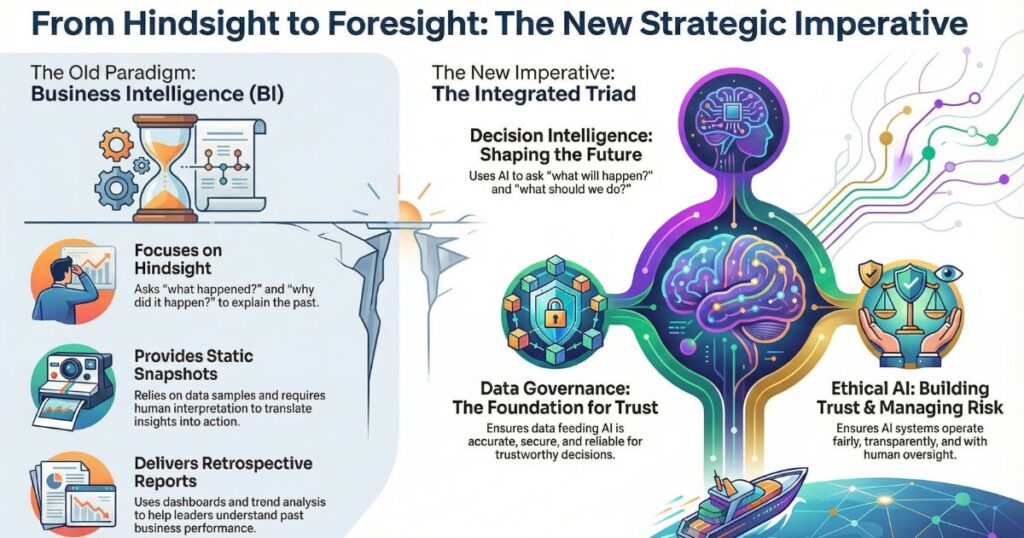
The distinction between Business Intelligence and Decision Intelligence reflects a fundamental shift in organizational philosophy about the role of analytics. Business Intelligence systems excel at retrospective analysis—they tell compelling stories about what happened and often illuminate why it happened. Through carefully designed dashboards, trend analyses, and diagnostic reports, BI tools help executives understand their business performance, identify bottlenecks, and spot patterns in historical data.
However, BI systems have inherent limitations. They typically work with data samples rather than comprehensive datasets, presenting static snapshots that require human interpretation to translate into action. A BI dashboard might reveal that customer churn increased by 15% last quarter, and it might even break down that increase by customer segment or geography. But it stops there, leaving managers to debate what actions to take and predict what might happen if they implement various interventions.
Decision Intelligence fundamentally reimagines this process. Rather than focusing primarily on visualization and reporting, DI platforms emphasize continuous risk and opportunity assessment. They merge artificial intelligence, machine learning, and domain expertise to provide not just insights but actionable recommendations. Where BI asks “what happened?” and “why did it happen?”, Decision Intelligence asks “what will happen?” and “what should we do about it?”
This distinction manifests in several key dimensions. BI relies predominantly on descriptive and diagnostic analytics, painting pictures of the past. DI incorporates predictive analytics to forecast future states and prescriptive analytics to recommend optimal actions. BI typically analyzes subsets of available data, constrained by processing limitations and the need for human-readable outputs. DI systems can integrate and analyze the full breadth of organizational data, breaking down silos and connecting seemingly disparate information sources to reveal hidden patterns and relationships.
Perhaps most importantly, DI platforms can both augment human decision-making and automate routine operational choices. For strategic decisions requiring nuance and judgment, DI surfaces predictive insights that enable faster, more confident choices by human leaders. For high-volume operational decisions—should we approve this transaction, how much inventory should we order, which customer receives which offer—DI can apply established models to automate millions of daily decisions with consistency and scalability that human teams cannot match.
This comprehensive approach, leveraging techniques like advanced AI models and graph analytics, allows organizations to mitigate risks more effectively and identify opportunities more rapidly. By connecting data points across traditional departmental boundaries, DI reveals insights that would remain invisible in siloed BI systems.
Decision Intelligence as an Engineering Discipline
Decision Intelligence has evolved into a recognized engineering discipline that extends beyond traditional data science by incorporating principles from social science, decision theory, and managerial science. This multidisciplinary foundation reflects a crucial insight: making better decisions requires more than just better algorithms. It demands a systematic understanding of how decisions are actually made in organizations, how cognitive biases affect judgment, how uncertainty should be quantified, and how organizational structures either enable or impede effective choice.
The discipline emerged from a practical recognition that many organizations struggle with what can be called the “complexity ceiling”—a fundamental mismatch between the sophistication of their decision-making practices and the complexity of the situations they face. As business environments become more dynamic, interconnected, and ambiguous, traditional decision-making approaches that worked in simpler contexts break down. Executives find themselves overwhelmed by data yet starved for insight, unable to connect actions to outcomes in systems characterized by feedback loops, time delays, and non-linear relationships.
Decision Intelligence seeks to bridge this gap by providing frameworks for best practices in organizational decision-making and methodologies for applying advanced computational technologies at scale. It unifies proven decision-making principles with the power of modern AI, creating structured approaches to navigate uncertainty and complexity.
The Role of AI and Machine Learning: Solving Ineffable Problems
While artificial intelligence and machine learning form core technical components of Decision Intelligence, DI encompasses much more than these technologies alone. Traditional machine learning education often focuses on the research dimension—teaching students how to develop new, more sophisticated algorithms and models. This is analogous to teaching people how to build better microwaves from scratch. While valuable for advancing the field, it’s not what most organizations need.
Applied Decision Intelligence focuses instead on using existing tools to solve concrete business problems—learning which recipes work best in which situations. At its essence, machine learning is a powerful pattern recognition system that learns from examples rather than explicit programming. Given enough data showing what happened in the past, ML algorithms can identify patterns and create models that predict or categorize new situations.
This capability is revolutionary because it allows us to solve problems where the decision rules are “ineffable”—situations where we cannot articulate explicit instructions but can provide examples of correct outcomes. Consider credit approval decisions. Writing explicit rules to capture all factors that indicate creditworthiness would be extraordinarily difficult, requiring countless conditional statements to account for complex interactions between income, debt, employment history, spending patterns, and hundreds of other variables. But by training a model on historical data showing which applicants repaid their loans, we can create systems that effectively learn these complex patterns.
Traditional machine learning typically addresses “single-link” analytical questions: “If I know X, what can I conclude about Y?” Decision Intelligence extends this to “multi-link” strategic questions: “If I take action X, what chain of consequences will unfold?” This latter question is far more complex because it involves understanding causal relationships, anticipating feedback loops, and modeling how systems evolve over time. It unifies complex systems thinking, machine learning, and decision analysis into an integrated approach.
Designing Decisions: The Power of Visual Frameworks
A fundamental principle of Decision Intelligence involves applying engineering practices to the process of decision-making itself. Just as software engineers use design patterns and architects use blueprints, Decision Intelligence practitioners use visual design languages to represent and analyze decisions systematically. This represents a significant advancement over informal methods like spreadsheet analyses or verbal debates, providing common frameworks for understanding decision structure.
Decision Modeling provides visual languages for representing chains of cause and effect, explicitly mapping how actions lead to consequences. The Causal Decision Diagram framework, for instance, designs the decision-making process by modeling it based on external requirements, desired goals, and anticipated outcomes. These diagrams make explicit what is often implicit in organizational discussions, revealing assumptions, identifying gaps in logic, and highlighting where additional data or analysis might improve decision quality.
One particularly valuable aspect of these visual frameworks is their ability to represent intangible elements that traditional quantitative models often ignore. Many critical business decisions involve factors like employee morale, organizational culture, brand reputation, and intellectual capital—elements that resist simple numerical quantification yet profoundly influence outcomes. Decision models can incorporate these intangibles by analyzing the chains of factors that constitute them, structuring qualitative considerations alongside financial metrics and machine learning outputs. This allows leaders to make more holistic assessments that balance diverse objectives, such as pursuing sustainable growth while maintaining employee satisfaction and brand integrity.
The Essential Foundation: Data Governance and Ethical AI
As artificial intelligence transforms strategic decision-making, the integration of robust Data Governance frameworks and Ethical AI principles has shifted from optional best practice to non-negotiable strategic requirement. This integration provides organizations with dual advantages: it mitigates risks while simultaneously creating value by building trust with stakeholders.
Data Governance: The Framework for Trustworthy Decisions
Data governance encompasses the comprehensive framework of policies, standards, and controls that dictate how data is collected, stored, processed, and utilized throughout an organization. Effective governance ensures that data feeding AI-driven decisions meets rigorous standards for accuracy, security, completeness, and alignment with organizational objectives.
Far from being merely a compliance burden, good governance serves as a strategic enabler. Organizations with clear governance structures defining data ownership, documenting data lineage, and establishing accountability are fundamentally better positioned to leverage AI-driven analytics effectively. They can trust their data, trace the provenance of insights, and move quickly to implement recommendations without fear that flawed information will lead them astray.
Conversely, poor governance creates cascading problems. Unreliable data produces biased or inaccurate AI outputs, leading to strategic misjudgments. Inadequate security controls expose organizations to breaches that damage reputation and trigger regulatory penalties. Unclear accountability structures mean that when things go wrong, no one knows who is responsible for fixing them. Organizations without proper governance may find themselves running afoul of regulations concerning data privacy, discriminatory practices, or financial reporting.
Key governance frameworks provide structured approaches to these challenges. International standards emphasize principles like data integrity, availability, and stewardship, establishing common language and expectations for how organizations should manage their information assets. Empirical research demonstrates that data governance maturity correlates positively with organizational performance, reducing decision errors and strengthening predictive capabilities while accelerating the time from insight to action.
Ethical AI: Establishing Boundaries and Building Trust
The ethical dimension of AI governance addresses a fundamental challenge: AI systems learn from historical data, and if that data reflects human biases, discriminatory practices, or systemic inequalities, AI models will perpetuate and potentially amplify those problems. An algorithm trained on hiring decisions from a company with historical gender imbalances may learn to favor male candidates. A credit scoring model built on data from communities with limited access to traditional banking may unfairly penalize applicants from those communities.
Ethical AI frameworks aim to prevent these harms by emphasizing core principles: fairness, accountability, transparency, and human oversight. These principles must be integrated throughout the AI lifecycle, from initial data collection through model training, validation, deployment, and ongoing monitoring.
Fairness requires that AI systems treat all individuals and groups equitably, avoiding discrimination based on protected characteristics like race, gender, age, or disability. Achieving fairness in practice proves challenging because “fairness” itself can be defined in multiple, sometimes contradictory ways. Should an algorithm ensure equal outcomes across groups, equal treatment within groups, or equal opportunity to achieve positive outcomes? Different contexts may demand different fairness criteria.
Accountability addresses the question of responsibility when AI systems cause harm. As algorithms gain autonomy, traditional accountability structures become strained. If a predictive model leads to a discriminatory lending decision or a financial loss, who bears responsibility—the data scientist who built the model, the executive who approved its deployment, the engineer who maintains it, or somehow the algorithm itself? Clear governance frameworks establish accountability by documenting decision rights, approval processes, and oversight mechanisms. Many organizations now employ algorithmic audit procedures or establish AI ethics committees to review potential impacts before deployment.
Transparency and explainability tackle the “black box” problem inherent in many advanced AI systems, particularly deep learning models. These systems can make highly accurate predictions while operating in ways that even their creators cannot fully explain. This opacity poses strategic risks, especially in high-stakes domains like healthcare, criminal justice, or financial services. Stakeholders demand to understand how consequential decisions are made. Explainable AI frameworks develop techniques to make algorithmic reasoning more interpretable, allowing decision-makers to understand and justify outputs while maintaining legitimacy and trust.
International bodies have established important guidelines for ethical AI governance. These frameworks emphasize human-centered approaches that respect democratic values and human rights, classify AI systems according to risk levels with corresponding compliance requirements, and integrate ethical considerations with data governance to create comprehensive oversight structures.
Navigating Implementation Challenges
Translating ethical principles into operational practices presents significant challenges. Abstract concepts like “fairness” or “transparency” lack universally accepted metrics, making evaluation complex and context-dependent. What constitutes fair treatment in one domain may not apply in another. An outcome that seems transparent to a data scientist may remain opaque to an end user.
Building effective governance requires more than just policies and procedures—it demands cultural transformation. Ethical behavior must be internalized as a shared organizational value rather than treated as a compliance obligation. This requires leadership commitment, ongoing education, clear communication of expectations, and willingness to make difficult tradeoffs when ethical considerations conflict with short-term business objectives.
Organizations that successfully navigate these challenges discover that ethical governance, far from constraining innovation, actually enables it by building the trust and credibility necessary for stakeholders to embrace AI-driven transformation. When employees, customers, regulators, and the public trust that an organization uses AI responsibly, they become more willing to share data, adopt new systems, and support ambitious initiatives.
Decision Intelligence in Practice: The AI-ERP Revolution
The application of Decision Intelligence is driving transformation in core organizational systems, particularly Enterprise Resource Planning platforms that serve as the operational backbone for most large enterprises. Traditional ERP systems excel at managing day-to-day transactions—processing orders, tracking inventory, recording financial activity, managing human resources. However, they typically lack the real-time intelligence and adaptive capabilities needed for strategic decision-making in dynamic environments.
The AI-ERP revolution represents the convergence of artificial intelligence with enterprise systems, fundamentally changing how companies allocate resources, optimize operations, and make decisions. This integration moves beyond simple automation of routine tasks to enable fundamentally new capabilities.
Transformative Capabilities of AI-Augmented ERP
AI-based ERP solutions integrate sophisticated computational models with diverse data sources, facilitating informed decision-making across all business functions. This enables a paradigm shift from traditional batch-mode analytics, where data is processed periodically to generate reports, to continuous real-time processing that provides always-current insights.
Predictive analytics for demand forecasting represents one of the most impactful applications. Machine learning algorithms analyze historical sales data alongside external information—market trends, weather patterns, economic indicators, social media sentiment—to predict future demand with unprecedented accuracy. This allows organizations to optimize inventory levels, reducing waste from overstock while avoiding lost sales from stockouts. The financial impact can be substantial, particularly for companies with extensive product portfolios or perishable goods.
Anomaly detection leverages unsupervised learning techniques to identify unusual patterns or outliers in business data. Unlike traditional rule-based systems that flag only known problematic patterns, machine learning models can detect novel anomalies that human analysts might miss. This proves crucial for fraud detection, where perpetrators constantly develop new schemes, and for operational efficiency, where unexpected patterns might indicate equipment failures, process inefficiencies, or data quality issues before they cause major problems.
Resource optimization employs reinforcement learning algorithms that learn optimal strategies through trial and error, much like a human learns through experience. These systems can manage complex processes like inventory allocation, workforce scheduling, or energy consumption, continuously adapting to changing conditions and improving performance over time. The algorithms balance multiple objectives—minimizing costs while maximizing service levels, for instance—and can handle complexity that would overwhelm traditional optimization approaches.
Perhaps most importantly, AI-augmented ERP systems enhance organizational agility by providing real-time insights that enable proactive rather than reactive decision-making. When supply chain disruptions occur, intelligent systems can immediately identify alternative suppliers, reroute shipments, and adjust production schedules. When demand surges unexpectedly, they can optimize resource allocation and flag potential bottlenecks before they impact delivery times. Research demonstrates that organizations using AI-augmented ERP significantly reduce response times to disruptions compared to those relying on traditional systems, translating to competitive advantages in dynamic markets.
Measuring Organizational Readiness: The Maturity Model Approach
Successfully adopting Decision Intelligence requires more than just technology investment. It demands organizational transformation across multiple dimensions, many of which are cultural and structural rather than technical. Maturity models provide frameworks for assessing current capabilities and charting paths toward more advanced states.
Comprehensive maturity assessments recognize that Decision Intelligence success depends on a confluence of factors spanning decision-making practices, strategic alignment, data infrastructure, workforce capabilities, and value measurement. Organizations typically progress through distinct stages of maturity, each characterized by different capabilities and challenges.
The Five Pillars of Decision Intelligence Maturity
Decision-making practices form the first pillar, assessing how organizations structure and execute their decision processes. At low maturity levels, decisions remain largely informal, driven by intuition and ad-hoc analysis. As maturity increases, organizations begin mapping and formalizing decision processes, explicitly identifying what decisions need to be made, who makes them, what information they require, and how outcomes will be evaluated. Highly mature organizations not only formalize decisions but actively seek opportunities to augment or automate them with AI where appropriate, recognizing which choices benefit most from machine intelligence versus human judgment.
Strategic alignment measures whether Decision Intelligence initiatives connect to organizational strategy and receive adequate executive support. Many AI projects fail not due to technical shortcomings but because they lack strategic sponsorship or alignment with business priorities. Mature organizations embed data and AI strategies into their broader business planning, with executive leadership championing initiatives, allocating sufficient resources, and establishing governance structures that balance innovation with appropriate oversight. This pillar often shows relatively high maturity because organizations understand intellectually that executive support matters, even when execution in other areas lags.
Data and technology infrastructure captures the technical foundation necessary for Decision Intelligence. This includes sophistication in data collection, quality of storage systems, ability to integrate information across sources, and capability to prepare data for AI consumption. Low-maturity organizations struggle with fragmented data silos, inconsistent definitions, poor quality, and legacy systems that resist integration. As maturity increases, organizations develop centralized data platforms, implement robust data quality processes, and create architectures that make data accessible to both human analysts and AI systems. Highly mature organizations treat data as a strategic asset with appropriate investment in infrastructure and governance.
People and processes examines workforce readiness and change management capabilities. Even the most sophisticated AI systems fail if people don’t understand them, trust them, or know how to incorporate them into workflows. This pillar assesses technical skills within the organization, workforce willingness to adopt new technologies, and the change management processes that help people adapt. Mature organizations invest heavily in data literacy programs, cultivate diverse teams combining technical and domain expertise, and establish clear processes for introducing new AI capabilities. They recognize that sustainable transformation requires cultural change, not just tool deployment.
Value measurement addresses perhaps the most challenging aspect: quantifying the business impact of Decision Intelligence initiatives. Many organizations struggle to move beyond vanity metrics like “number of AI projects deployed” to rigorous measurement of financial and operational outcomes. This difficulty partly reflects the complexity of attribution—when an AI system recommends an action and a human decides to follow that recommendation, how much credit belongs to the AI versus the human judgment to trust it? Mature organizations develop frameworks for measuring both financial returns and non-financial benefits like risk reduction or improved customer satisfaction, tracking metrics over time and using them to continuously improve their AI systems and deployment approaches.
Patterns Across Organizations and Geographies
Maturity assessments reveal interesting patterns when analyzed across organizations and geographies. Average maturity levels typically fall in the middle range, with organizations having progressed beyond initial exploration but not yet achieving optimization or transformation. This suggests that many companies recognize the importance of Decision Intelligence and have begun implementation, but few have fully realized its potential.
Geographic differences emerge from both technical and cultural factors. Some markets show higher maturity due to starting from more advanced technology baselines, avoiding delays caused by legacy system constraints. But technology alone doesn’t explain geographic variation—organizational culture and communication practices prove equally important. Organizations that effectively communicate their AI strategies throughout all levels, where senior leadership models support for transformation and junior staff demonstrate enthusiasm for new approaches, achieve higher maturity regardless of their starting point. The structure of data teams also matters; organizations that embed data practitioners within operational teams rather than isolating them in centralized functions tend to develop better organizational data literacy and more successful AI implementations.
Industry patterns reflect inherent characteristics of different sectors. Highly digitalized industries with limited physical infrastructure naturally achieve higher maturity because they work primarily with digital information and face fewer constraints from physical assets. Technology companies and financial services firms lead in maturity, having both strong technical capabilities and business models that directly reward data-driven decision-making. Conversely, industries dependent on extensive physical infrastructure—transportation, logistics, utilities—struggle more with both the technical challenges of integrating physical and digital systems and the difficulty of quantifying AI value in contexts dominated by physical assets and traditional operational metrics.
Conclusion: The Imperative for Integrated Excellence
The convergence of Decision Intelligence, Data Governance, and Ethical AI represents far more than a technological evolution—it embodies a fundamental reimagining of how organizations create value, manage risk, and sustain competitive advantage in an increasingly complex and fast-moving world.
Decision Intelligence moves organizations beyond retrospective analysis to proactive strategy, providing the predictive and prescriptive capabilities necessary for agility in environments characterized by uncertainty and rapid change. It enables companies to identify opportunities before competitors, mitigate risks before they materialize, and make millions of operational decisions with consistency and speed impossible for human teams alone. The transformation from explaining what happened to shaping what will happen represents a quantum leap in organizational capability.
Yet this power demands responsibility. The same technologies that enable unprecedented insight can also perpetuate bias, violate privacy, and concentrate power in opaque systems that resist accountability. This is why Data Governance and Ethical AI are not separate initiatives but essential components of Decision Intelligence itself. Governance provides the foundation of data quality and integrity necessary for AI systems to function reliably. Ethics ensures that those systems operate fairly, transparently, and in alignment with human values. Together, these elements transform data from a potential liability into a trusted strategic asset.
Organizations that view governance and ethics as constraints to be minimized fundamentally misunderstand the strategic landscape. Companies that embed ethical considerations throughout their AI lifecycle, supported by robust governance frameworks, demonstrate greater resilience when facing regulatory scrutiny, faster trust-building with customers and partners, and stronger employee engagement from workforces that take pride in responsible innovation. Ethical governance is not a cost center but a value creator, enabling organizations to move boldly while managing risks intelligently.
The practical implementation of this integrated approach requires sustained commitment. It demands investment in technology infrastructure and data platforms, certainly, but equally in workforce development, cultural transformation, and leadership evolution. Executives must understand AI sufficiently to ask informed questions without needing to become data scientists themselves. Middle managers must learn to incorporate algorithmic insights into their decision processes while retaining appropriate skepticism and judgment. Frontline employees must develop sufficient data literacy to understand how AI systems affect their work and to provide feedback that improves those systems.
Organizations must also resist the temptation to pursue AI for its own sake, measuring success by the number of models deployed rather than business value created. The goal is not AI adoption but better decisions—choices that more consistently achieve organizational objectives while respecting ethical boundaries and managing risks. This requires rigorous value measurement, clear attribution of outcomes, and willingness to sunset AI initiatives that don’t deliver meaningful benefits.
Looking forward, competitive advantage will increasingly accrue not to organizations that merely collect the most data, but to those that govern and use data most intelligently and ethically. The companies that will thrive are those that view the integration of Decision Intelligence, Data Governance, and Ethical AI not as separate tracks but as mutually reinforcing elements of a comprehensive strategic framework—a framework that makes them simultaneously more capable and more trustworthy, more innovative and more responsible, more data-driven and more human-centered.
This confluence represents the foundation for long-term success in an era where technology evolves at breathtaking speed but stakeholder expectations for transparency, fairness, and accountability evolve just as rapidly. Organizations that master this integration position themselves not just to survive disruption but to lead through it, creating sustainable value for shareholders, customers, employees, and society. The question is no longer whether to embrace this integrated approach, but how quickly and effectively each organization can build the capabilities, structures, and culture it demands.