
Table of Contents
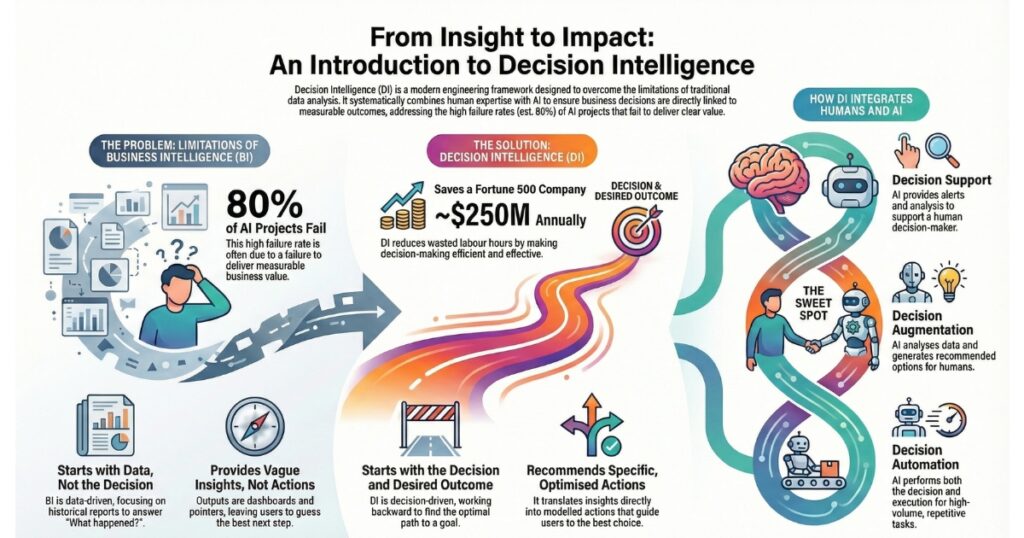
Decision Intelligence (DI) has emerged as a critical discipline aimed at revolutionising how organizations navigate complexity and achieve specific, measurable business outcomes in the age of Artificial Intelligence (AI). In a world saturated with data and accelerating technological change, traditional decision-making processes, often plagued by ambiguity, high AI project failure rates (estimated at 80% due to failure to deliver measurable business value), and analytical inertia, are proving insufficient. DI offers a structured, outcome-oriented framework that systematically integrates human expertise with advanced computational capabilities to ensure that every decision is purposeful, efficient, and aligned with organizational goals.
Defining the Decision Intelligence Discipline
Decision Intelligence is fundamentally an engineering discipline that augments data science with theory from social science, decision theory, and managerial science. It is defined as a methodology for forming a decision aimed at achieving a specific outcome. For the most part, DI represents the application of AI to enhance the quality and accuracy of decisions while making the decision-making processes more efficient.
The core objective of DI is to help organizations make better decisions by assisting decision makers in understanding how the potential actions they can take today will affect their desired outcomes in the future. This focus differentiates DI from conventional data-driven approaches, positioning it as a decision-driven practice that is outcome-oriented and efficiency-focused. Gartner recognized the strategic importance of this field, naming Decision Intelligence as a top strategic technology trend for 2022, predicting that 33% of large organizations would practice it by 2023.
Key to the DI approach is the understanding that decision-making is based on the chain of cause and effect: how an action leads to an outcome. Decision Intelligence serves as the discipline for analyzing this causal chain, utilizing techniques like Decision Modeling and the Causal Decision Diagram (CDD), which functions as a visual language for representing these relationships.
DI evolved because organizations reached a “complexity ceiling,” characterized by a mismatch between the sophistication of their decision-making practices and the complexity of the situations demanding decisions. It seeks to overcome this by unifying decision-making best practices and serving as a framework that brings advanced analytics and machine learning (ML) techniques directly to the non-expert decision maker.
The Crucial Distinction: DI vs. Business Intelligence (BI)
Decision Intelligence emerged largely to address the limitations of traditional Business Intelligence (BI) tools and the associated shortcomings of relying solely on data science insights. While BI and DI share similarities, their distinctions are crucial for understanding DI’s purpose and value proposition.
Focus and Methodology
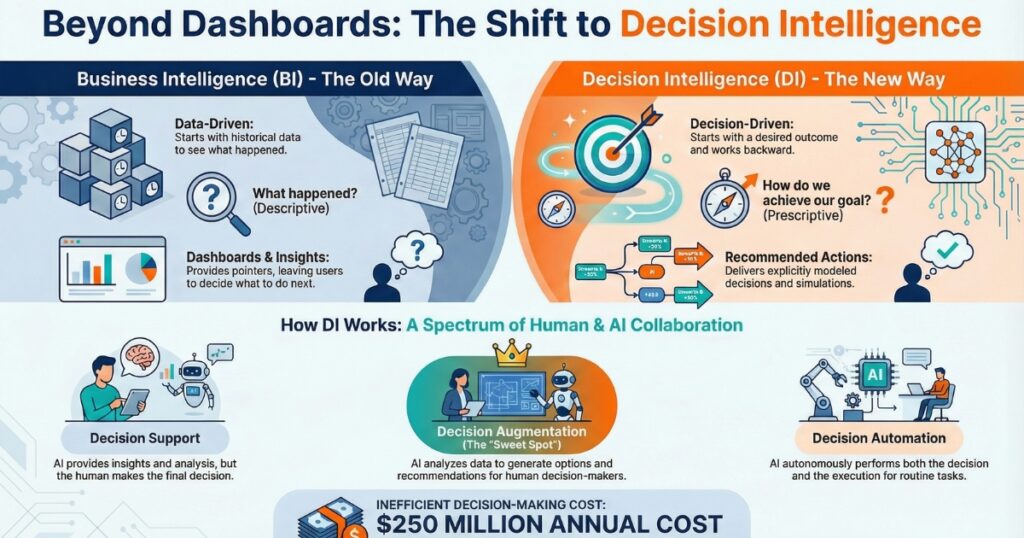
The fundamental difference lies in their starting point: BI is typically data-driven, resulting in dashboards and reports, whereas DI is decision-driven and outcome-oriented.
- Data-Driven vs. Decision-Driven:
- BI Focus: Traditional BI tools focus on visualizations, reports, and descriptive analytics to answer the what—which Key Performance Indicator (KPI) or metric changed. It mines historical data, generating queries and visualizations to support business decisions.
- DI Focus: Decision Intelligence begins by defining the decision and the desired business impact. It adopts an inverted V approach, where the decision defines the data, tools, and queries needed. DI aims to shift teams from a data-centric approach to a decision-centric approach.
- Scope of Analytics:
- Legacy BI is primarily suited for descriptive analytics. Users can access the what but struggle to obtain the deeper context of the data (the why) needed for action and decision-making.
- Modern data organizations recognize the need for a range of descriptive, diagnostic, predictive, and prescriptive analytics. DI bridges this gap by expediting the identification of the what (descriptive) to find the why (diagnostic), ultimately enabling the how (predictive and prescriptive) within data. Predictive analysis determines what will happen, and prescriptive analysis identifies how it will impact outcomes.
- Output and Actionability:
- BI outputs often consist of pointers or insights that indicate possible decisions but do not suggest a course of action, leaving users unsure of what step to take or which option offers the most value.
- DI, conversely, translates insights into recommended actions. It integrates what is known into a decision process. Insights alone do not inherently drive business change; DI closes this gap by providing explicitly modelled decisions using logic, data, and context to guide and automate movement toward business outcomes.
- Democratization and User Experience:
- Legacy BI often requires analytics creators to interpret results for analytics consumers, slowing down decision-making.
- DI democratizes access by supporting both analysts and consumers. DI solutions use conversational, natural language input and feedback, translating business questions into big-data search queries. This simplifies the complexity of exploration and analysis, making it as intuitive as a search engine.
The Core Mechanism: Integrating Human and Artificial Intelligence
Decision Intelligence is characterized by its integration of human expertise and AI capabilities, recognizing the limitations and strengths of each. AI is leveraged through automation, machine learning (ML), and advanced data analysis to uncover key drivers and patterns that are not easily visible, circumventing the need for manual data crunching that often leads to missed insights.
Forms of Decision Intelligence and the PI-AI Mix
DI solutions are categorized based on the degree of machine autonomy, providing a spectrum of collaboration between People Involvement (PI) and Artificial Intelligence (AI).
| DI Form | Level of Automation | Role and Function |
|---|---|---|
| Decision Support | Low/Moderate AI, High PI | Machines support human decision-making with visualizations, searches, alerts, and descriptive analysis. The human remains the decision-making body. |
| Decision Augmentation | High AI, Moderate PI | Machines analyze data to generate recommendations and options for human decision-makers. This is frequently cited as the current sweet spot for AI-powered DI technology. |
| Decision Automation | Full AI, Low/No PI | Machines perform both the decision and execution steps autonomously. This is suitable for highly repetitive operational decisions, which gain high business value from volume and replicability. |
DI serves as a framework that integrates human and machine intelligence to enhance the outcomes of decisions. The AI world has often focused on fully automated use cases, overlooking decisions where humans remain in the loop (hybrid or augmented decisions), a critical gap that DI fills.
Human vs. Machine Strengths
DI advocates for allocating human resources (PI) only to the most critical, complex, and high-value decisions, leaving routine tasks to AI.
- Machine Strengths: AI/ML excels at performing tasks at scale, handling high complexity in data, and operating at instantaneous speeds in high-velocity contexts. AI systems are better at solving specific problems in structured environments. They offer high replicability and predictable outputs.
- Human Strengths: Humans accommodate loosely defined decision search spaces and can exercise judgment and intuition to address ill-structured objectives. Human decision-making is necessary in complex or non-programmed situations where information is incomplete or ambiguous, requiring creative thinking and thoughtful judgment. Humans also bear the responsibility for decision outcomes, as machines do not.
DI, therefore, is about bundling human and machine intelligence, enabling humans to channel resources into decisions requiring unique capabilities such as critical thinking and emotional intelligence.
The Decision Intelligence Framework and Methodology
Decision Intelligence operates via a structured, systematic process, moving beyond ad-hoc choices toward rigorous, repeatable decision-making. The methodology is decision-centric, meaning it starts with the desired outcome and works backward.
The Decision-First Approach and Modeling
The initial step in DI is deciding the outcome first and working backward to define the processes and information needed to achieve that result. This model, often referred to as the Inverted V, contrasts with the traditional data-driven approach where analysis leads to insights, which then vaguely point toward an action. In DI, the goal is fixed at the outset, ensuring every step is purposefully aligned to deliver the predetermined business impact.
A central tool in the methodology is the Causal Decision Diagram (CDD), which functions as a “decision blueprint”. The CDD allows the decision to be visibly designed, aligning stakeholders and technologists around the rationale. A CDD explicitly maps actions (sets of choices that influence outcomes) to outcomes (measurable targets) through intermediates (steps along the causal chain) and identifies externals (factors outside the decision-maker’s control).
Decision modeling is crucial because it makes the decision-making process transparent using an engineering framework. Furthermore, the concept of optimization is considered the very foundation of most AI-driven decision-making agents, helping systems find the most optimal or feasible solution to a problem.
The 5-Phase DI Methodology (Pratt/O’Callaghan)
The Decision Intelligence methodology comprises nine steps structured across five iterative phases designed to manage complex decisions:
- Phase A: Decision Requirements: This phase focuses on setting the boundaries and scope of the decision.
- A1. Decision Objective Statement: Creating a clear statement that outlines the core decision and serves as the “north star”.
- A2. Decision Framing: Defining constraints, boundaries, and verifying the decision’s suitability for DI (decision verification).
- Phase B: Decision Modeling: This phase focuses on documenting the causal model.
- B1. Decision Design: Creating the initial CDD (the blueprint) for the decision.
- B2. Decision Asset Investigation: Identifying existing data, models (including AI/ML), and human expertise relevant to the CDD.
- Phase C: Decision Reasoning: Using the model to evaluate potential choices.
- C1. Decision Simulation: Creating a digital twin of the CDD to simulate how different actions lead to outcomes and identify optimal choices, often employing linear programming or operations research techniques.
- C2. Decision Assessment: Evaluating the model’s fidelity, accuracy, uncertainty, and risk.
- Phase D: Decision Monitoring: Tracking the implemented decision in the real world.
- D1. Decision Monitoring: Tracking key decision outcomes against metrics and KPIs after an action has been taken, allowing for continuous feedback loops.
- Phase E: Decision Review: Retaining learnings and ensuring continuity.
- E1. Decision Artifacts Retention: Storing decision models (CDDs), documentation, and knowledge as corporate assets for reuse and continuous improvement.
- E2. Decision Retrospective: Analyzing the effectiveness of the decision taken.
Pillars of a DI Strategy and Organizational Requirements
Implementing DI is not merely about using AI tools; it requires a holistic, systematic approach involving people, processes, and technology, underpinned by a necessary cultural shift.
The Five Pillars of DI Implementation
Experts identify five core pillars essential for a scalable and sustainable Decision Intelligence strategy in modern organizations:
- Decision Clarity: An organization must define what decisions really matter, who owns them, what metrics define success (KPIs), and what input data and people are required. This pillar forces the creation of a shared map of key decisions, treating them as assets.
- Data Foundation: A reliable, trusted data foundation is paramount. This requires a unified metadata framework, clear data lineage (tracing data from source to report), and continuous data quality monitoring. Without clean, governed data, predictive and prescriptive analytics become guesswork.
- Analytics and Dashboards (Decision Systems): This involves moving beyond passive data display toward systems that enhance understanding and provide real-time views. The focus shifts to AI-Augmented Insights, which apply advanced analytical techniques (including machine learning) in the background to surface patterns, predict outcomes, and recommend actions, providing clear explanations for transparency.
- Operational Agility/Decision Velocity: This concerns the speed and efficiency with which a decision-making process can be executed. DI facilitates continuous learning, enabling organizations to adapt quickly and move from reactive responses to anticipatory planning.
- Leadership and Culture: This non-technological pillar is crucial. A strong DI culture requires leaders to set clear expectations, promote accountability (each critical decision has a named owner), and foster open communication, allowing teams to question assumptions and models with evidence. The goal is to spend more time shaping the future (forecasting) than fighting current crises (fire drills).
The DI Organization and the 4Rs
A mature Decision Intelligence organization optimizes the use of technology, data, and human capabilities to make effective and informed decisions across all units. Such an organization must foster a culture grounded in trust, courage, transparency, experimentation, and psychological safety.
This maturity is often cultivated through adherence to the four key structural functions (The 4Rs):
- Rhythm: Maintaining a consistent and aligned heartbeat for company workflows, communication, and development processes.
- Reflection: Encouraging continuous learning and individual and team reflection, enabling fast adoption and turning failures into growth opportunities.
- Rigor: Sticking to agreed rhythms and sustaining commitment to decisions on every level of the company.
- Recovery: Maintaining the sustainable resilience of team members and the organization.
Delivering Measurable Business Value
Decision Intelligence addresses a fundamental business problem: the significant cost and risk associated with poor or slow decision-making. By forcing alignment between decision intent and measurable impact, DI ensures that technology investments yield tangible returns, accelerating decision velocity and increasing efficiency.
Quantifiable Impact and Efficiency
The operationalized decision-making enabled by DI provides the capability to quantify the business impact of decisions. Companies adopting DI report measured improvements in speed, efficiency, flexibility, and growth. For a typical Fortune 500 company, inefficient decision-making processes can cost approximately $250 million annually in wasted labor hours. By contrast, DI solutions reduce the waste and high failure rates associated with undirected AI projects.
Organizations with high DI maturity are significantly more likely to meet or exceed financial targets, grow and develop people, retain top talent, effectively anticipate and react to change, and improve employee productivity and adherence to regulatory compliance. AI-powered DI leaders show improvements in customer retention and product or service innovation compared to followers.
Examples of AI-Powered DI in Action
DI is universally applicable across business functions, with key applications in supply chain, finance, and risk management.
- Financial Services: Decision Intelligence platforms automate complex decision-making in critical areas such as credit scoring, risk assessment, and loan origination through a combination of machine learning, process automation, and a business rules engine. This automation increases efficiency and flexibility, granting the agility needed to adapt to industry changes and remain competitive.
- Consumer Packaged Goods (CPG) Acceleration: A large CPG company, leveraging AI-generated recommendations and thousands of automated decisions, recorded 220,000 recommendations sent to decision intelligence users in five months, showcasing how DI accelerates decision velocity.
- Risk Mitigation: DI enables organizations to understand and simulate risks before they materialize, moving the company from a reactive stance to a proactive and strategic one.
In essence, Decision Intelligence provides the architectural backbone that turns fragmented data into aligned, explainable, and continuously improving actions. It closes the gap between knowing (insights) and doing (actions), ensuring that better decisions become the natural outcome, faster and more scalable across the entire organization.
Analogy to solidify understanding: Decision Intelligence is like an architect designing a building. Traditional Business Intelligence (BI) might tell you how many bricks were used last year and predict how many might be needed next month, based on historical patterns. However, DI starts by designing the exact building you want (the decision and outcome) and then works backward. It determines the materials, structural integrity, team skills, costs, and timeline needed, using simulations and engineering principles (AI, machine learning, decision theory) to ensure the design leads directly to the desired, measurable outcome, rather than just hoping the available materials lead to a sound structure.