Table of Contents
Every leader, entrepreneur, and knowledge worker has one daily challenge in common: making decisions under pressure and uncertainty. We’re constantly asked to choose strategies, judge people, interpret data, resolve conflicts, and predict future outcomes. Most of us believe we do this well—after all, we’re rational adults with experience, expertise, and intelligence.
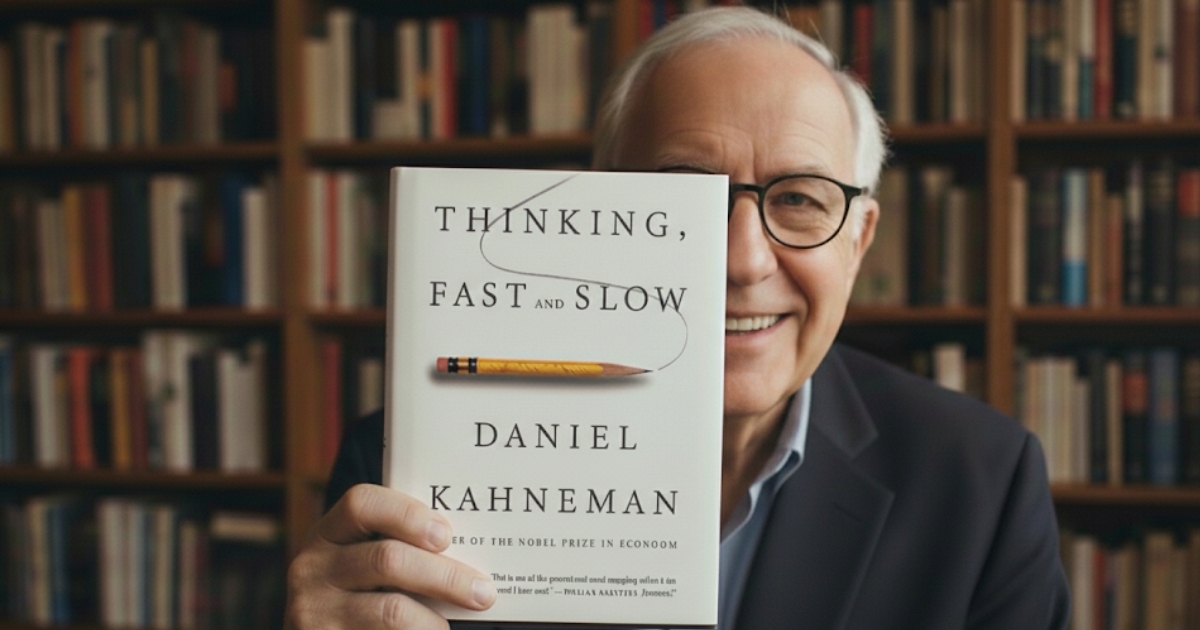
Yet one of the most influential psychology books of the last century argues that the confidence we place in our own decision-making abilities is often misplaced. Daniel Kahneman’s Thinking, Fast and Slow reveals that the human mind, while extraordinary in many ways, is also prone to shortcuts and illusions that can lead us to the wrong conclusions with surprising ease.
This book has become essential reading for leaders, innovators, and professionals in every field—not because it teaches rote techniques for better decisions, but because it profoundly changes the way we understand how our minds actually work. It challenges the belief that we are rational thinkers and replaces it with a more accurate and nuanced picture of a mind driven by two competing systems: one fast and intuitive, the other slow and deliberative.
Understanding these systems isn’t just intellectually interesting—it’s immensely practical. In modern organizations, where information moves fast and consequences are high, recognizing these mental patterns can help you avoid costly errors and improve the quality of your choices. Whether you’re evaluating a business opportunity, designing a product, negotiating a contract, or simply deciding how to allocate time, Kahneman’s insights offer a unique advantage.
Let’s explore why this book is so important and what decision makers can gain from it.
The Core Premise: Two Systems Governing One Mind
Kahneman organizes the book around two modes of thinking:
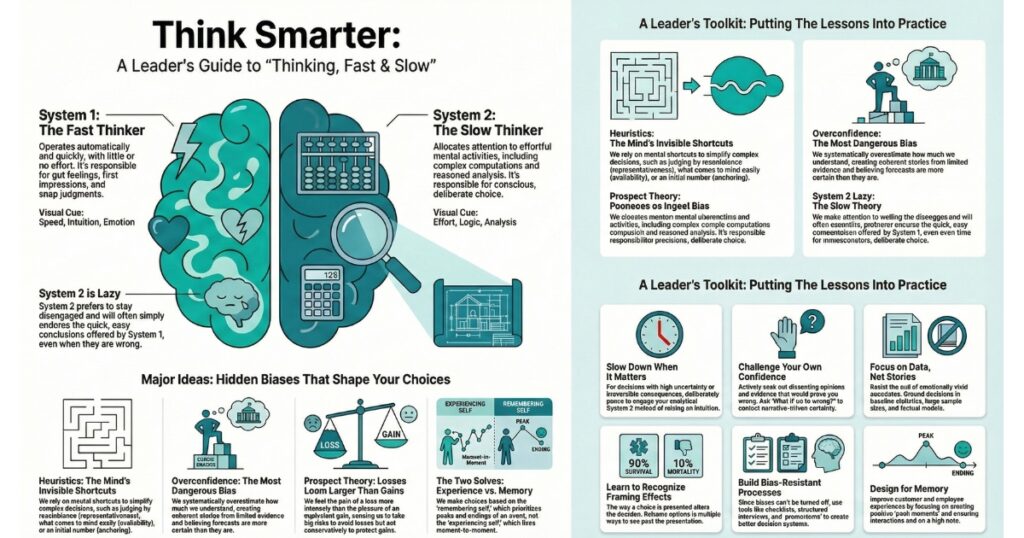
- System 1 — fast, intuitive, emotional, automatic
- System 2 — slow, analytical, deliberate, effortful
These systems are not literal parts of the brain but metaphors that describe different patterns of mental activity.
System 1: The Fast Thinker
System 1 runs continuously. It allows you to instantly recognize a face, detect emotion in a voice, read a simple sentence, or brake suddenly when a car swerves in front of you. It’s the system behind gut feelings, first impressions, instincts, and snap judgments.
It is effortless, efficient, and incredibly capable. Without it, you would be overwhelmed by daily life.
But there’s a catch: System 1 is also biased. It jumps to conclusions, invents patterns that don’t exist, substitutes easy questions for harder ones, and relies on stereotypes. Its shortcuts often work—but when they fail, they fail predictably.
System 2: The Slow Thinker
System 2 takes effort. You feel it when you solve a math problem, reason through a difficult conversation, evaluate complex data, or resist temptation. System 2 is engaged when you think something through step by step.
It’s the system responsible for reasoned judgment and conscious decision making.
But System 2 is lazy. It prefers not to engage unless absolutely necessary. Often, it simply endorses the quick judgments offered by System 1—even when those judgments are wrong.
This interplay between two modes of thought creates both the brilliance and the fallibility of human decision making.
Why Leaders Should Care
Decision makers operate in a fast-moving world filled with incomplete information, complex problems, and emotional pressure. This is exactly the environment where System 1 dominates—and where biases can quietly mislead.
Kahneman’s research shows that even highly trained professionals—doctors, judges, investors, executives—fall prey to predictable cognitive errors. Intelligence does not immunize you. Experience does not guarantee accuracy.
Recognizing these biases allows you to design safeguards, adopt more robust processes, and make decisions that rely on more than instinct alone.
A Deep Dive into the Book’s Major Ideas
1. The Dual-System Model of Thinking
Kahneman beautifully explains how much of our thinking arises outside conscious awareness. System 1 constantly generates impressions and feelings; System 2 simply adopts them unless something triggers deeper scrutiny.
For example, when you see a picture of an angry face, you don’t analyze it—you instantly know the emotion. That’s System 1 at work. But if someone asks you to multiply 17 × 24, System 2 must take over.
This distinction matters because many decisions feel as easy as recognizing an angry face—but they’re not. Leaders often assume they “just know” whether a strategy is sound or a candidate is right for the job. Kahneman teaches us to pause before trusting that feeling.
2. Heuristics and Biases: The Invisible Shortcuts
Kahneman and his research partner Amos Tversky transformed our understanding of judgment through their work on heuristics—mental shortcuts that simplify decisions.
Some of the most important include:
- The representativeness heuristic — judging based on resemblance instead of facts
- The availability heuristic — relying on what comes easily to mind
- Anchoring — being overly influenced by an initial number or idea
- The halo effect — allowing one trait to influence overall judgment
- Regression to the mean — misunderstanding natural variation
- Substitution — answering an easier question without noticing it
These shortcuts explain everything from hiring mistakes to investment errors. Leaders who understand them can spot flawed thinking in themselves and others.
3. Overconfidence: The Most Dangerous Bias
Kahneman argues that humans systematically overestimate how much they understand. We weave coherent stories from limited evidence, making events seem predictable when they were actually unpredictable.
This is especially dangerous for leaders:
- Forecasts feel more certain than they are.
- Plans seem more executable than reality allows.
- Narratives feel clearer and more causal than the messy world truly is.
- Past successes appear to validate skill rather than luck.
One of Kahneman’s most valuable contributions is helping readers see the limits of their own knowledge.
4. Prospect Theory and the Nature of Risk
Prospect Theory earned Kahneman the Nobel Prize because it fundamentally reshaped economics. Rather than treating humans as rational maximizers of utility, it shows that we evaluate choices relative to gains and losses—not absolute outcomes.
Losses loom much larger than gains. People will take significant risks to avoid a loss but often act conservatively to protect a gain.
This helps explain:
- Why investors hold losing stocks too long
- Why people overpay for insurance
- Why employees resist change
- Why negotiations can stall over small concessions
Leaders who understand Prospect Theory can better anticipate behavior and craft choices that align with human psychology.
5. The Two Selves: Experience vs. Memory
Kahneman closes the book by showing that humans have two different selves:
- The experiencing self, which lives moment to moment
- The remembering self, which tells the story afterward
These selves value different things. The experiencing self cares about how moments feel. The remembering self cares about how events are remembered, especially their peaks and endings.
This insight has enormous implications:
- Customers judge experiences by their best and worst moments, not the average.
- Employees remember key interactions, not daily routines.
- People make future choices based on remembered stories, not lived experiences.
For leaders, understanding the remembering self can improve customer journeys, organizational culture, and personal wellbeing.
Putting Kahneman’s Lessons into Practice
Theory is powerful, but the value of Thinking, Fast and Slow lies in how it can change everyday leadership behavior. Here are the most practical lessons leaders and entrepreneurs can apply immediately.
1. Slow Down When It Matters
Most of the time, fast thinking is efficient and appropriate. But important decisions—hiring, strategy, investments, product launches—require deliberate analysis.
Signs that you should slow down include:
- High uncertainty
- Irreversible consequences
- Emotional intensity
- Surprising or unusual situations
- Decisions that rely heavily on intuition alone
Taking that pause to engage System 2 can prevent avoidable mistakes.
2. Challenge Your Own Confidence
Confidence is often a product of System 1 narrative-making, not evidence.
To counter this:
- Ask: “What evidence would prove me wrong?”
- Look for alternative explanations.
- Seek out uncomfortable data.
- Invite dissenting opinions.
- Compare your forecast to historical base rates.
These practices keep decision makers grounded in reality.
3. Focus on Data, Not Stories
Humans are drawn to anecdotes because they’re emotionally vivid and easy to remember. Data is harder work.
But strong decisions require:
- Baseline statistics
- Large sample sizes
- External comparisons
- Factual models rather than narratives
Kahneman shows that people often ignore statistical evidence in favor of “what feels right.” Leaders must resist this.
4. Learn to Recognize Framing Effects
The way a choice is presented—to yourself or others—can dramatically alter the decision. For example:
- “90% survival rate” sounds better than “10% mortality rate,” even though they are identical.
- “A discount for paying early” feels different from “a penalty for paying late.”
Before making a decision, reframe the options in multiple ways to ensure you’re choosing based on facts, not presentation.
5. Build Bias-Resistant Decision Processes
Because the mind’s biases cannot be switched off, leaders must create systems that compensate for them.
Some powerful tools include:
- Premortems — imagining a project has failed and explaining why
- Red teams — assigning people to challenge plans
- Checklists — to reduce cognitive load and oversight
- Structured interviews — to avoid halo effects in hiring
- Decision logs — to track reasoning and prevent hindsight bias
Over time, these structures create a culture of disciplined thinking.
6. Design Experiences That Account for Memory
Since people remember peaks and endings, not total duration, leaders can improve experiences by:
- Ending meetings, processes, events, or interactions on a positive note
- Designing “peak moments” for customers and employees
- Avoiding long stretches of low-grade frustration
- Being mindful of how people will retell their story later
This applies to everything from onboarding to leadership offsites to customer service.
7. Reduce Cognitive Load for Yourself and Your Team
Mental energy is limited. Decisions made under cognitive strain are worse.
To reduce unnecessary load:
- Simplify communication
- Limit multitasking
- Reduce unnecessary meetings
- Provide clarity in roles and goals
- Create predictable systems wherever possible
Less noise in the environment leads to clearer strategic thinking.
Why This Book Matters Today More Than Ever
The modern world is filled with complexity, information overload, and rapid change. Leaders face a barrage of decisions every day, many of which have long-term implications.
In this environment, intuition alone is not enough. Every organization is now a “decision factory,” and the quality of those decisions determines success or failure.
Thinking, Fast and Slow teaches us to:
- Understand the hidden forces driving our thinking
- Avoid predictable errors
- Slow down when we need clarity
- Balance intuition with analysis
- Create systems that go beyond individual judgment
It provides leaders with vocabulary, tools, and mental frameworks that fundamentally change how they see themselves and others.
This book is not just a guide to thinking—it’s a guide to becoming a wiser, more reflective, and ultimately more effective decision maker.
Final Thoughts
Thinking, Fast and Slow is one of those rare books that permanently shifts how you view the world. Once you understand the two-system model, you begin to see its implications everywhere—in how teams collaborate, how customers choose products, how negotiations unfold, how forecasts are made, and how leaders rise or fall.
Daniel Kahneman doesn’t promise perfect rationality. He promises awareness. And awareness is the first step toward better decisions.
For leaders and entrepreneurs, this book offers a roadmap for navigating complexity with clearer judgment and deeper insight. It helps you understand not just how others think—but how you think.
If you haven’t read it yet, put it at the top of your list. If you’ve read it before, read it again. Its lessons only grow more valuable with time.