
Table of Contents
Charlie Munger: Latticework of Mental Models
In a world full of noise, uncertainty, and endless decisions, most solopreneurs rely on gut instinct, past experience, or whatever feels right in the moment. The result? Costly mistakes, missed opportunities, and constant second-guessing. Charlie Munger, the brilliant thinker and longtime partner of Warren Buffett, offered a far better way. He developed a powerful thinking system called the latticework of mental models — an interconnected web of practical ideas drawn from psychology, economics, business, science, and more. Instead of depending on a single perspective or isolated facts, Munger trained himself to combine multiple models to see reality more clearly. This article shows you exactly how to build and use this latticework in your business. You’ll learn a simple, repeatable process to make sharper decisions about clients, pricing, offers, time, and growth — so you can work smarter, reduce regret, and build a more sustainable and profitable solo venture.
Running a business means every decision lands directly on you. Which client to accept, what to charge, whether to launch that new offer, how to spend the next four hours — there is no one to catch your blind spots, no board to interrogate your reasoning, no colleague to flag what you missed. One bad call can cost weeks of revenue. A pattern of bad calls produces burnout that takes months to recover from.
Charlie Munger understood this long before “solopreneur” entered the vocabulary. Over decades of high-stakes decision-making, he developed a practical discipline he called the latticework of mental models — a connected web of thinking tools drawn from psychology, economics, physics, biology, and business. It is not a checklist to memorise. It is a flexible framework that helps you see hidden risks, identify genuine opportunities, and stop repeating the same expensive mistakes.
This article gives you the full 129-model latticework rewritten for solopreneurs — plain-English, commercially grounded, and illustrated with real business scenarios. It also gives you a simple way to start applying it this week without adding more complexity to your plate.
The Problem With Solo Decisions
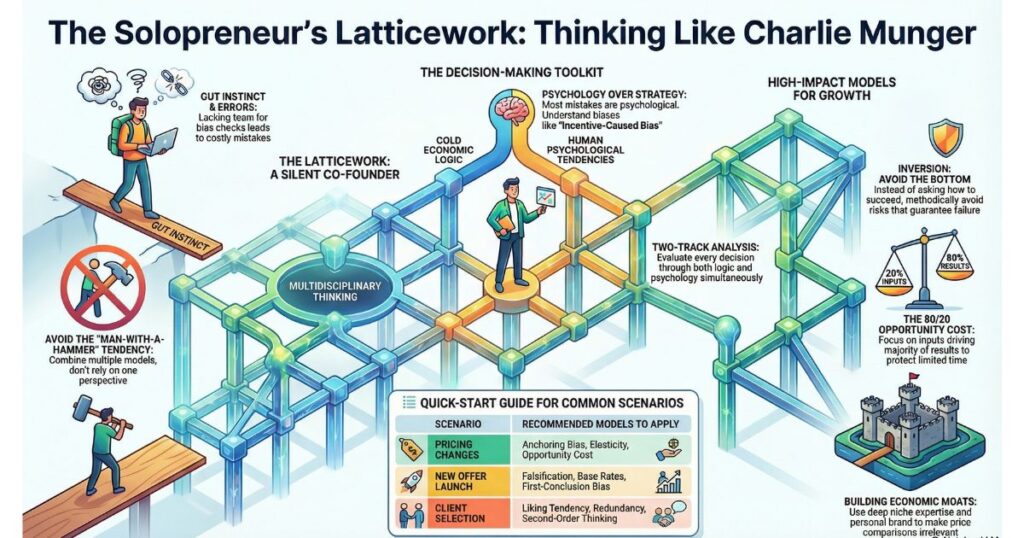
Most solopreneurs make decisions the way most people drive — competently most of the time, but relying far more on instinct and habit than they realise. That works until it does not. A client who “seems nice” absorbs six weeks of capacity and pays half what you needed. A pricing decision made under pressure locks you into a rate that kills your margins for a year. A new offer built on excitement rather than evidence launches to silence.
The underlying problem is not intelligence or effort. It is the absence of a systematic framework for thinking under pressure. Munger’s diagnosis was precise: most individuals and organisations fail not because they lack information, but because they rely on isolated facts or gut feeling — a single model applied to every situation. The friendly client overrides the economic reality. The exciting opportunity overrides the opportunity cost calculation. One vivid recent win distorts your read of the base rate.
The solution he proposed was to build what he called “worldly wisdom” — big ideas drawn from many disciplines, woven into a connected mental structure. When facing a real decision, you draw from several categories simultaneously rather than reaching for the same familiar heuristic every time. The result is clearer thinking under pressure, fewer decisions you later regret, and a compounding track record of choices that actually build toward something.
For solopreneurs, the practical value of this is significant. You do not have a team to catch errors. The latticework functions as a silent co-founder — structured, consistent, and free of the biases that cloud individual thinking.
What the Latticework Actually Is
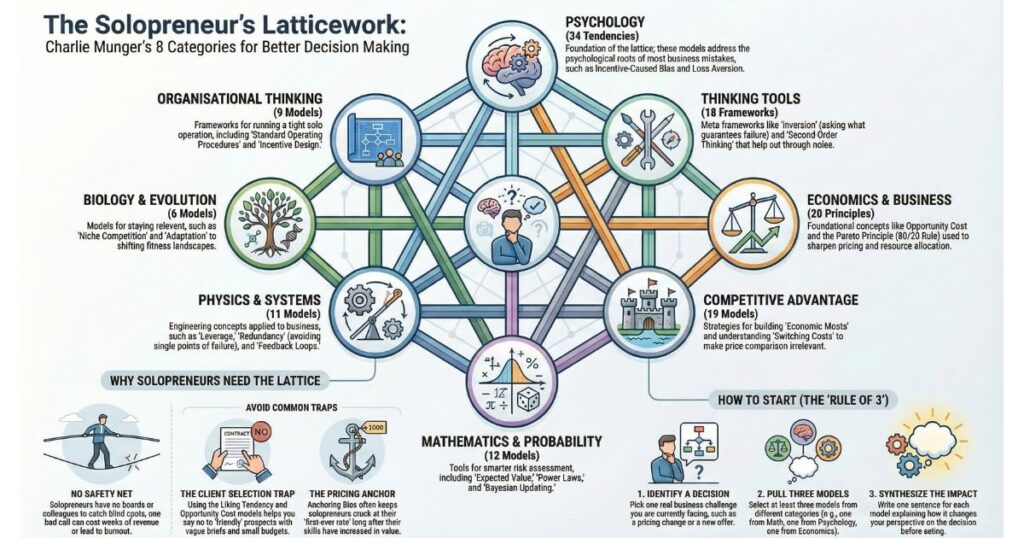
Munger grouped his 129 models into eight broad categories: psychology, thinking tools, economics and business, competitive advantage, mathematics and probability, physics and systems, biology and evolution, and organisational behaviour. Each model is a distilled idea from its source discipline, translated into practical terms.
The categories are not independent. That is the point. When you face a pricing decision, you are dealing with economics (opportunity cost, marginal utility), psychology (anchoring bias, overoptimism), and business strategy (differentiation, switching costs) simultaneously. Pulling models from multiple categories is what gives the latticework its analytical depth. One model alone is a hammer. Several models from different disciplines is a proper toolkit.
Munger’s most direct statement of the concept came in a 1994 talk at USC: to be genuinely useful, elementary ideas from different disciplines must be arranged into a structure where each one reinforces the others. He was describing what cognitive scientists would later call “transfer learning” — the ability to apply reasoning from one domain to solve problems in another. The solopreneur who understands evolutionary biology’s concept of niche competition thinks differently about market positioning than one who only reads business strategy books. The solopreneur who understands engineering’s redundancy principle designs their income streams differently than one who only tracks monthly revenue.
The AI coaching frameworks at AI Coach take a similar cross-disciplinary approach — building mental infrastructure for better business decisions rather than just providing tactical advice.
Why Solopreneurs Need It More Than Anyone
Large organisations have structural compensations for individual bias. Committees catch overoptimism. Finance teams stress-test projections. Legal reviews slow down bad decisions. None of those mechanisms exist for a solopreneur. Every bias you carry operates unchecked unless you build a deliberate system for catching it.
This matters most in four recurring scenarios that most solopreneurs face:
Client selection. The liking tendency, the halo effect, and reciprocation pressure all operate together when a friendly prospect arrives with a vague brief and an undersized budget. Without a framework, you say yes. With the latticework, you identify the bias, run the opportunity cost calculation, and make a deliberate choice.
Pricing decisions. Anchoring bias locks solopreneurs into the rate they first charged a client — sometimes years after their skills and results have made that rate irrational. Overoptimism distorts revenue projections. Loss aversion makes raises feel riskier than they are. These three biases together keep many solopreneurs underpriced indefinitely.
Offer development. Confirmation bias ensures you only notice the feedback that supports the offer you have already decided to build. Availability bias makes the most recent market signal feel like a trend. First-conclusion bias closes down the thinking process before better options have been considered.
Energy and capacity management. Hyperbolic discounting makes the immediate $500 gig more appealing than a $3,000 project paid over six months. Status quo bias keeps you running at 110% capacity rather than restructuring how you work. The stress-influence tendency then compounds every other bias when you are operating at the edge of your energy.
Twinlabs covers the structural side of this — how AI tools can reduce the cognitive load on solopreneurs so they spend more time on decisions that actually require human judgement.
The latticework does not eliminate these pressures. It gives you a consistent structure for noticing them before they determine the outcome.
Psychology: The 34 Tendencies That Cost You Money
Munger placed psychology first for a specific reason: most solo business mistakes have a psychological root, not a strategic one. You know what you should do. The bias determines what you actually do. Understanding these tendencies is the single highest-return investment in your decision-making capacity.
Every model below follows the same format: the rule in plain English, its source, and a realistic solopreneur example.
1. Reward and Punishment Superresponse Tendency
Rule: People change behaviour dramatically when rewards or punishments are attached — far more than logic or data alone would predict.
Source: B.F. Skinner’s operant conditioning (1930s–40s).
Example: You promise yourself a full day off only after completing three client proposals. Suddenly the procrastination disappears and they are done in half the time.
2. Liking/Loving Tendency
Rule: When you like someone, you automatically ignore their flaws and amplify the positives.
Source: Edward Thorndike’s halo effect (1920); Cialdini’s Influence (1984).
Example: A prospect shares your values. You overlook the unclear scope and accept the project at a discount. Three weeks in, you regret it.
3. Disliking/Hating Tendency
Rule: When you dislike someone, you focus exclusively on flaws and dismiss anything good.
Source: Negative halo effect from Thorndike’s research; evolutionary friend-or-foe instincts.
Example: You do not enjoy a corporate client’s communication style. The pay is excellent and the work is straightforward — but you only see the slow payment terms and decline.
4. Doubt-Avoidance Tendency
Rule: The brain dislikes uncertainty and rushes to a conclusion even without adequate information.
Source: Classic psychology of cognitive dissonance.
Example: A dream client sends a vague enquiry. You immediately write a full proposal instead of asking three clarifying questions first.
5. Inconsistency-Avoidance Tendency
Rule: Once committed to a plan or idea, you resist changing it to avoid feeling wrong.
Source: Leon Festinger’s cognitive dissonance theory (1950s).
Example: You have offered the same service package for two years. It no longer fits your ideal clients, but you keep tweaking it rather than rebuilding from scratch.
6. Curiosity Tendency
Rule: Humans have a natural drive to explore and learn, but deadlines bury it.
Source: Basic human psychology observed by Munger.
Example: You block 30 minutes every Friday to read outside your niche. A month later, you use what you learned to design a higher-value offer.
7. Kantian Fairness Tendency
Rule: You expect fair treatment and extend it to others by default.
Source: Immanuel Kant’s philosophy of universal rules.
Example: You reframe a negotiation: “Let’s structure this so it works for both of us if the roles were reversed.” The price discussion becomes a mutual problem to solve.
8. Envy and Jealousy Tendency
Rule: Seeing others succeed produces pain even when your own situation has not changed.
Source: Classic psychological bias.
Example: A competitor lands a large contract on LinkedIn and you immediately question your entire positioning. You return to your own monthly revenue trend and the feeling passes.
9. Reciprocation Tendency
Rule: Receiving a favour creates a felt obligation to return it.
Source: Cialdini’s Influence.
Example: You offer a prospect a free 30-minute audit. The obligation created increases the probability they book the full engagement.
10. Influence-from-Mere-Association Tendency
Rule: Feelings about one thing transfer automatically to anything associated with it.
Source: Psychological association studies.
Example: You decline a collaboration with a brand that has a questionable reputation, knowing the association affects how clients perceive you.
11. Simple, Pain-Avoiding Psychological Denial
Rule: You unconsciously ignore uncomfortable realities to protect comfort.
Source: Everyday ego protection observed by Munger.
Example: Revenue has been flat for three months. You explain it as a slow season until you actually look at the numbers and discover the real cause is underpricing.
12. Excessive Self-Regard Tendency
Rule: Most people overestimate their own abilities and the quality of their work.
Source: Munger’s repeated warning.
Example: You believe your sales page is solid until three past clients give you honest feedback and reveal it confuses them.
13. Overoptimism Tendency
Rule: You overestimate positive outcomes and underestimate the time and risk involved.
Source: Behavioural psychology.
Example: A product launch you estimate at two weeks runs to five. You now apply a 2x multiplier to all time estimates before committing.
14. Deprival-Superreaction Tendency
Rule: Losing something you have feels far worse than gaining the equivalent thing feels good.
Source: Loss aversion research by Kahneman and Tversky.
Example: You frame a retainer renewal as protecting steady income the client already has, not as gaining something new. Renewals become easier to close.
15. Social-Proof Tendency
Rule: What others are doing functions as evidence of what is correct.
Source: Cialdini’s Influence.
Example: Every business you follow is launching a $97 digital product. You pause and ask: “Would I still build this if no-one else were?”
16. Contrast-Misreaction Tendency
Rule: You judge value by contrast rather than by absolute measure.
Source: Psychological contrast effect.
Example: Your R8,500 package looks cheap next to a competitor’s R25,000 offer. You step back and ask whether R8,500 is actually fair for what you deliver.
17. Stress-Influence Tendency
Rule: High stress amplifies every other bias and impairs judgement.
Source: Basic physiology and psychology.
Example: You have a strict rule: no important proposals or difficult client responses sent when you are exhausted or hungry.
18. Availability-Misweighing Tendency
Rule: Recent or vivid information receives too much weight in your thinking.
Source: Tversky and Kahneman.
Example: One client ghosts you and you conclude that all clients are unreliable. You check your records: 92% pay on time. The conclusion was produced by one vivid event.
19. Use-It-or-Lose-It Tendency
Rule: Skills and capacities fade without regular practice.
Source: Munger’s observation.
Example: You practise sales conversations every Monday morning, even during slow periods, so your close rate does not slip when work resumes.
20. Drug-Misinfluence Tendency
Rule: Substances distort thinking and reduce impulse control.
Source: Observable reality.
Example: No significant business decisions after 8pm. Non-negotiable.
21. Senescence-Misinfluence Tendency
Rule: Cognitive and physical capacity changes with age; planning for it is rational, not morbid.
Source: Biological reality.
Example: You begin documenting your processes now so your business can operate without your daily presence in ten years.
22. Authority-Misinfluence Tendency
Rule: You defer to perceived experts even when they are wrong.
Source: Milgram experiments and everyday observation.
Example: A prominent industry figure recommends an expensive platform. You interrogate the recommendation before purchasing rather than deferring automatically.
23. Twaddle Tendency
Rule: People fill conversations with low-value content.
Source: Munger’s term.
Example: Client calls run 25 minutes with a fixed agenda. Without structure, the same conversations run 60 minutes and produce no better outcomes.
24. Reason-Respecting Tendency
Rule: Providing a reason — any reason — dramatically increases compliance.
Source: Cialdini’s research.
Example: When requesting a testimonial, you explain precisely why it helps other solopreneurs at the same stage as the client. The response rate doubles.
25. Lollapalooza Effect
Rule: Multiple biases operating simultaneously produce an extremely powerful combined force.
Source: Munger’s term for compounding psychological effects.
Example: During a product launch you notice social proof, liking tendency, and overoptimism all operating at once. You run the numbers before acting on any of them.
26. Confirmation Bias
Rule: You seek evidence that confirms what you already believe and discount the rest.
Source: Classic cognitive bias research.
Example: You believe your newsletter is your strongest marketing channel and only notice positive data. You pull the full analytics and find the conversion rate is lower than you thought.
27. Hindsight Bias
Rule: After an event, you feel you knew it would happen — even when you did not.
Source: Psychological research on memory distortion.
Example: After a client project fails, you reconstruct warning signs that were not actually recorded beforehand. You now keep a decision journal to distinguish real foresight from hindsight.
28. First-Conclusion Bias
Rule: You accept the first plausible answer and stop thinking.
Source: Munger’s misjudgement framework.
Example: A prospect says they love your proposal. You treat the deal as closed instead of confirming next steps and a timeline.
29. Anchoring Bias
Rule: Your first piece of information becomes the reference point for all subsequent judgement.
Source: Tversky and Kahneman.
Example: Your first client paid R12,000. Three years later you unconsciously anchor all quotes near that figure despite delivering significantly more value.
30. Incentive-Caused Bias
Rule: Incentives distort your perception of reality itself.
Source: Munger’s central psychology insight.
Example: You offer a large discount for upfront payment and find yourself suddenly convinced the client is a perfect fit — despite a vague brief and several yellow flags.
31. Pavlovian Association
Rule: Automatic responses develop in relation to specific triggers, independent of conscious choice.
Source: Pavlov’s classical conditioning.
Example: The ping of a new email pulls you out of deep work automatically. You disable notifications during focused blocks and the response weakens within a week.
32. Hyperbolic Discounting
Rule: Immediate rewards are valued far above equivalent future rewards.
Source: Behavioural economics.
Example: You accept a quick R4,500 project over a R28,000 engagement paid across six months. The instant availability of the smaller amount made it feel more valuable than it was.
33. Representativeness Bias
Rule: You judge situations by how closely they resemble a familiar pattern or category.
Source: Tversky and Kahneman.
Example: A prospect looks and sounds like your best client ever. You skip proper qualification and discover three months in that the resemblance was superficial.
34. Status Quo Bias
Rule: You prefer things to remain as they are and resist change disproportionately.
Source: Behavioural psychology.
Example: You are still using an invoicing system you know is inefficient because switching feels disruptive. You calculate the time cost of staying with it and switch.
Thinking Tools: 18 Frameworks That Cut Through Noise
If the psychology models help you notice what is distorting your thinking, the meta-frameworks help you think more rigorously once the distortions are identified. These are the structural tools — the processes Munger applied to decisions.
1. Inversion
Rule: Instead of asking how to succeed, ask what would guarantee failure — and avoid that.
Source: Carl Jacobi’s mathematical principle; Munger’s most-used tool.
Example: Before increasing your rates, you list everything that would cause you to lose all your clients. You address those risks first, then raise the price.
2. Checklist Approach
Rule: A simple, repeatable list prevents forgetting critical steps under pressure.
Source: Atul Gawande’s The Checklist Manifesto; Munger’s pilot-inspired habit.
Example: A seven-item checklist runs before every client proposal: scope, payment terms, revision policy, deadline, deliverables, communication channel, and success criteria.
3. Two-Track Analysis
Rule: Evaluate every situation through both economic logic and human psychology simultaneously.
Source: Munger’s core framework.
Example: New offer pricing: Track 1 covers your costs and target margin. Track 2 asks how the client will emotionally receive the number. Both tracks must work.
4. Elementary Worldly Wisdom
Rule: Master the handful of genuinely important ideas from each major field.
Source: Munger’s lifelong practice.
Example: Basic psychology and economics, properly understood, let you read client behaviour patterns that most solopreneurs operating purely on intuition miss entirely.
5. Latticework of Mental Models
Rule: Connect ideas from different disciplines into one usable web of thinking.
Source: Munger’s central metaphor.
Example: A decision to niche down draws on Circle of Competence, Opportunity Cost, and Second-Order Thinking simultaneously rather than relying on one perspective.
6. Multidisciplinary Approach
Rule: Deliberately borrow concepts from fields outside your direct expertise.
Source: Munger’s core philosophy.
Example: Reading evolutionary biology leads you to apply niche competition theory to your market positioning — and you find a less contested segment.
7. Circle of Competence
Rule: Know precisely what you understand well and what you do not.
Source: Munger and Buffett’s investing principle.
Example: A prospect asks you to include website redesign in a copywriting engagement. You decline that element specifically because it falls outside your competence and would eat time you cannot recover.
8. First Principles Thinking
Rule: Break problems down to their most fundamental truths and reason up from there.
Source: Aristotle; endorsed by Munger.
Example: Instead of copying competitors’ pricing, you decompose your offer to its core value: “What specific problem does this solve and what is that worth to the client?” Then you build your rates from that foundation.
9. Second-Order Thinking
Rule: Always consider the long-term and indirect consequences of any action.
Source: Munger’s emphasis on consequences.
Example: Accepting a high-paying but demanding client feels correct at first order. At second order, you realise it will consume the capacity you need to build your own product — the decision reverses.
10. Occam’s Razor
Rule: The simplest explanation with the fewest assumptions is usually correct.
Source: 14th-century philosopher William of Ockham.
Example: Revenue dropped. The simplest explanation is that you stopped consistent outreach three months ago. You verify this rather than constructing complex explanations about market conditions.
11. Hanlon’s Razor
Rule: Do not attribute to malice what is adequately explained by incompetence or misunderstanding.
Source: Robert J. Hanlon.
Example: A client is two weeks late on payment. You assume oversight rather than bad intent and send a straightforward reminder. It was an oversight.
12. Falsification
Rule: Actively seek evidence that would prove your belief wrong.
Source: Karl Popper’s philosophy of science; Munger applied it consistently.
Example: Before launching a new offer, you ask three ideal clients why they would not buy it. The answers reshape the offer significantly.
13. Scenario Analysis
Rule: Map several plausible future outcomes rather than betting on a single forecast.
Source: Business and military planning.
Example: Before committing to a new tool, you model best-case, base-case, and worst-case outcomes on your cash flow. The worst case reveals a liquidity risk you had not considered.
14. Mental Accounting
Rule: You treat money differently depending on where it came from or how it is labelled.
Source: Richard Thaler’s behavioural economics.
Example: A tax refund arrives and you treat it as discretionary spending. It is revenue. You reinvest it the same way you would treat any other income.
15. Black Swan Events
Rule: Rare, high-impact events that cannot be forecast precisely but dominate outcomes over time.
Source: Nassim Taleb.
Example: A platform algorithm change eliminates your primary traffic source in a week. You maintain three independent income streams specifically because black swans are not foreseeable.
16. Gray Rhino Events
Rule: Highly probable, high-impact risks that are clearly visible but routinely ignored.
Source: Michele Wucker.
Example: One client represents 45% of your revenue. You know this is dangerous. You have been delaying diversification for eight months. This model names it for what it is: a gray rhino.
17. Vivification
Rule: Abstract concepts stick only when made concrete and specific.
Source: Munger’s communication style.
Example: You describe your service as “the diagnostic system for businesses that are busy but not growing” rather than “strategic consulting.” Prospects understand it immediately.
18. Man-with-a-Hammer Tendency
Rule: If your only tool is a hammer, every problem looks like a nail.
Source: Munger’s warning against narrow thinking.
Example: You solve every business problem with more content. Eventually you apply other models and discover that pricing — not visibility — is the constraint.
The practical business guides at 1 Hour Guide work on similar principles — distilling complex decisions into structured, repeatable thinking frameworks that solopreneurs can apply without a management team.
Economics and Business: 20 Principles That Sharpen Your Pricing and Positioning
1. Supply and Demand
Rule: Prices rise when demand exceeds supply; they fall when supply exceeds demand.
Example: More solopreneurs are offering the same service. You differentiate and raise prices rather than competing on cost.
2. Elasticity
Rule: Demand sensitivity to price changes varies significantly by market and offering.
Example: You test a 20% price increase and find demand barely moves. Your service is price-inelastic. You raise the base rate permanently.
3. Opportunity Cost
Rule: Choosing one option means forgoing the value of the best alternative.
Example: Ten hours on a R6,000 project is ten hours not spent building a R40,000 product. The calculation changes the decision.
4. Comparative Advantage
Rule: Both parties benefit by specialising in what each does relatively best, even if one is better at everything.
Example: You are competent at design but exceptional at copywriting. You outsource the design and charge premium rates for the copy.
5. Marginal Utility and Diminishing Returns
Rule: The additional benefit from one more unit decreases as you add more.
Example: Your fifth marketing channel of the week produces a fraction of what the first two produced. Consolidate before expanding.
6. Time Value of Money
Rule: Money available now is worth more than the same amount later because of its earning potential.
Example: You structure offers with upfront payment or short retainer cycles. Waiting 60 days to receive what you are owed has a real cost.
7. Incentives and Incentive Alignment
Rule: People reliably respond to incentives; misaligned incentives produce predictable dysfunction.
Example: You design your own reward system — a specific experience or purchase — tied to hitting a monthly revenue target. It changes your daily behaviour.
8. Agency Problem
Rule: People you hire may pursue their own interests rather than yours.
Example: You give a virtual assistant clear output targets and a bonus tied to your business goals. Their success becomes a function of yours.
9. Information Asymmetry
Rule: When one party knows significantly more than the other, outcomes are less efficient for the less-informed party.
Example: You reduce it for your clients with transparent project roadmaps, clear deliverables, and well-documented case studies. Informed clients make faster decisions.
10. Adverse Selection
Rule: When buyers cannot distinguish quality, high-quality providers exit the market.
Example: You use detailed case studies and outcome-based guarantees to signal quality. This filters out price-shoppers and attracts serious clients.
11. Moral Hazard
Rule: People take more risk when they do not bear its full cost.
Example: You require a deposit before starting work. Clients with skin in the engagement stay engaged.
12. Pareto Principle (80/20 Rule)
Rule: Roughly 80% of outcomes come from 20% of inputs.
Example: Four clients generate 80% of your revenue. You concentrate your best energy there and stop subsidising the rest with your time.
13. Gresham’s Law
Rule: In competition, the lower-quality form tends to crowd out the higher-quality one.
Example: Low-rate gig platforms drive down expectations for the entire category. You move to direct premium clients and exit the platform.
14. Creative and Competitive Destruction
Rule: Innovation eliminates old industries while creating new ones.
Example: AI writing tools displace commodity content work. You move to strategy and positioning — the layer AI cannot yet replace.
15. Intrinsic Business Value
Rule: The real worth of a business is the present value of its future owner earnings.
Example: You calculate what your business is worth to a rational buyer. It forces you to think about client concentration, systems, and recurring revenue differently.
16. Mr Market
Rule: Markets are irrational in the short term; a rational operator uses that irrationality rather than being driven by it.
Source: Benjamin Graham via Munger.
Example: Economic uncertainty causes clients to pause. You hold your rates and stay consistent. Several competitors discount. When confidence returns, your positioning is intact.
17. Margin of Safety
Rule: Proceed only when there is a sufficient buffer against error.
Example: Three months of operating expenses in cash before committing to any significant business investment. Non-negotiable.
18. Tax Deferral and Compounding
Rule: Delaying tax payments allows capital to compound longer.
Example: You use a tax-advantaged retirement structure for a portion of business profits so the compounding runs for decades rather than being reduced annually.
19. Value Creation vs. Value Capture
Rule: Not all value you create for clients is captured by you — some goes to clients, some to competitors.
Example: You build personal brand and structured contracts specifically to increase the proportion of the value you create that you actually keep.
20. Obsolescence Risk
Rule: Every business decays without continuous innovation.
Example: You review your service offering quarterly to assess whether any component is being made redundant by an AI tool or a market shift.
The AI business advisory at AI Coach works through several of these economic principles in the context of how solopreneurs can integrate AI tools without undermining their own value — a practical application of the creative destruction and obsolescence risk models.
Competitive Advantage: 19 Models for Building a Moat No-one Can Copy
1. Economic Moats
Deep niche expertise and genuine personal relationships create barriers competitors cannot easily replicate. Most solopreneurs compete on price because they have no moat. Your moat should be the thing that makes price comparison irrelevant.
2. Cost Advantages
Automating administrative work keeps your effective hourly rate higher than competitors who handle everything manually. You are not reducing your price — you are reducing your cost of delivery.
3. Differentiation and Brand Power
Your personal story, process transparency, and consistent positioning create perceived uniqueness. Clients choose you not because you are cheapest but because you are the most clearly relevant option for their specific situation.
4. Switching Costs
Deliverables that are deeply integrated into a client’s operation create genuine switching friction. The more embedded your work, the more disruptive replacing you becomes.
5. Network Effects
A private community of clients grows in value as membership grows — each new member adds referral potential, peer learning, and social proof for the next.
6. Scale Economies (Supply Side)
A digital product created once can be sold to hundreds with near-zero marginal cost. This is the structural advantage of productised offerings for solopreneurs.
7. Scale Economies (Demand Side)
A larger newsletter audience becomes more valuable to sponsors and partners, which in turn funds better content, which attracts a larger audience.
8. Learning Curve
After 50 client engagements, your delivery is significantly faster and more accurate than it was at 10. Your accumulated experience is a structural cost advantage that new entrants cannot shortcut.
9. Distribution Control
Your email list and personal brand are distribution channels you own. Platform-dependent solopreneurs are one algorithm change from losing their audience.
10. Winner-Take-Most Markets
In a narrow niche, the best-known practitioner captures a disproportionate share of the available work. Being the clear leader in a small category beats being average in a large one.
11. Moat Durability
Assess whether your advantage will erode. Deep personal relationships are durable. A specific software skill is not. Build toward the durable categories.
12. Industry Structure
Generalist freelance platforms attract cutthroat price competition. Specialist niches with fewer capable practitioners support better rates and more rational client behaviour.
13. Rational vs. Cutthroat Competition
Avoid markets where competitors discount aggressively for volume. Find or build a segment where quality is the primary decision criterion.
14. Platform Economics
A membership or community model connects members with each other and with resources, creating value that grows as the platform grows.
15. Capacity Discipline
Over-promising delivery capacity produces burnout and quality decline. Both damage your moat. Constrained supply, properly managed, supports better rates.
16. Surfing Long Waves
Align your positioning with powerful, multi-year trends rather than fighting them. The solopreneur economy, AI integration, and remote professional services are structural shifts — not fads.
17. Technology as Friend vs. Competitor
AI tools can either accelerate your output or replace your output depending on where you position. At the level of execution, AI competes. At the level of judgement and strategy, it assists. Position accordingly.
18. Lean Operations
A solo operation with clean processes and no overhead is structurally more agile than a small agency with fixed costs and coordination overhead. That agility is itself a competitive asset.
19. Cancer-Surgery Formula
Sometimes removing a significant but toxic element — a difficult client, an unprofitable service line, a distracting side project — is necessary to protect the health of the broader business.
Twinlabs specifically examines how AI tools can strengthen rather than undermine a solopreneur’s competitive position — the technology-as-friend application of this category.
Mathematics and Probability: 12 Models for Smarter Risk Decisions
1. Basic Arithmetic Fluency
Comfort with percentages and compound calculations is non-negotiable. A 15% price increase on a R120,000 annual revenue base adds R18,000 — with near-zero additional effort. Most solopreneurs have not done this calculation.
2. Expected Value
Probability-weighted average outcomes allow rational comparison between uncertain options. A strategy with a 20% chance of a R50,000 outcome has a higher expected value than one with a 95% chance of a R5,000 outcome.
3. Probabilistic Thinking and Base Rates
Most new offers fail at launch — the base rate is high. Knowing this before you build is more useful than being surprised by it after.
4. Bayesian Updating
Early feedback is weak evidence. You update your belief about a new offer’s potential as real data arrives — not from the first response, which is almost always too small a sample to be meaningful.
5. Regression to the Mean
An unusually strong revenue month is likely to be followed by something more average. Plan conservatively after peaks, not optimistically.
6. Normal Distribution vs. Fat Tails
Monthly revenue for most solopreneurs follows a rough bell curve — but occasionally, a single client, referral, or piece of content produces an outlier result. Building for resilience requires planning for both the typical distribution and the tail events.
7. Power Laws
A small number of your content pieces drive most of your inbound leads. A small number of your clients generate most of your revenue. Identify and concentrate on the high-power inputs.
8. Cost-Benefit Analysis
Every tool, course, or outsourced function must clear a direct cost-benefit calculation — time saved, revenue added, or risk reduced — before committing.
9. Compounding
One high-quality newsletter per week compounds into a meaningful audience in two years. The discipline required is consistent, not dramatic. The returns are non-linear.
10. Optionality and Asymmetric Payoffs
Small experiments with limited downside and uncapped upside are structurally superior to large commitments with symmetrical risk. Test first, scale what works.
11. Kelly-Type Thinking
Never risk a significant proportion of your operating capital on a single launch, client, or investment. The Kelly criterion exists to prevent ruin even when the expected value is positive.
12. Permutations and Combinations
Your existing skills, audiences, price points, and delivery models can be recombined in more ways than most solopreneurs realise. New offers often do not require new capabilities — they require new combinations.
Physics, Engineering and Systems: 11 Models for a Resilient Business
1. Critical Mass
There is a point in audience or client base growth where momentum becomes self-sustaining. Before that point, growth requires active effort. After it, referrals and inbound leads reduce the required effort significantly.
2. Leverage
A single well-constructed sales page, positioned correctly, generates enquiries for years. One hour of creation, sustained returns. Identify the high-leverage assets in your business and build more of them.
3. Redundancy
Single points of failure in a solopreneur business are high-risk. One primary client, one platform, one income stream — any of these disappearing creates an immediate crisis. Redundancy is not inefficiency. It is structural resilience.
4. Breakpoints and Phase Transitions
Some growth feels slow and linear until it suddenly becomes non-linear. Consistent content publication, for example, often produces little visible result for months before tipping into sustained inbound. The physics are real: momentum accumulates before it becomes visible.
5. Friction and Efficiency
Every unnecessary step in your client onboarding, delivery, or payment process creates friction that costs you time and creates dissatisfaction. Reducing friction is not just an operational improvement — it directly affects client retention.
6. Safety Margins
Every project timeline should include a 30% buffer. Every cash projection should include a 20% reduction from optimistic assumptions. Safety margins are not pessimism — they are the engineering discipline that keeps systems functional when individual components underperform.
7. Positive Feedback Loops
Satisfied clients produce referrals, which produce satisfied clients. High-quality content attracts higher-quality audience members, who attract better collaborators. Identifying and reinforcing your positive feedback loops is among the highest-return activities available to a solopreneur.
8. Negative Feedback Loops (Stabilising)
When you set a revenue target that automatically triggers a price review or capacity restructure, you have built a stabilising feedback loop into your business. These self-correcting mechanisms prevent drift toward burnout or underpricing.
9. Bottlenecks and Constraints
For most solopreneurs, the binding constraint is their own time and cognitive capacity. Automating or outsourcing everything else first is the correct response to this constraint — not working longer hours.
10. Nonlinearity
Small inputs can produce disproportionate outputs depending on system state. A single well-placed piece of content at the right moment can generate more enquiries than months of paid advertising. You cannot always predict which input will be nonlinear — but you can structure your work to produce many of them.
11. System Resilience vs. Fragility
Fragile businesses break under pressure. Resilient ones absorb it. Antifragile ones — Taleb’s term — get stronger from it. A solopreneur with multiple income streams and strong personal brand actually improves their positioning when market disruption eliminates competitors who were operating on thin margins and single clients.
Biology and Evolution: 6 Models for Staying Relevant
1. Evolution by Natural Selection
Your business adapts by retaining what clients pay well for and discarding what they do not. Sentiment about a service offering is not data. Revenue retention is.
2. Adaptation and Fitness Landscapes
The environment changes continuously. What worked two years ago may not work now — not because your execution declined but because the landscape shifted. Continuous adaptation is not optional.
3. Red Queen Effect
You must keep improving just to maintain your current position because the people and tools you are competing with are also improving. Standing still is the same as moving backward relative to the field.
4. Niches and Ecological Competition
Direct competition within a crowded niche is structurally difficult. Carving a specific niche — solopreneur business coaches, financial services copywriters, KZN-based hospitality consultants — reduces direct competition and increases your perceived authority within that segment.
5. Population Dynamics
Markets cycle. The solopreneur boom of recent years will attract more entrants until the returns decline. Avoid over-expanding during the boom phase. Position for the consolidation that follows.
6. Autopsy Learning
Failures contain more actionable information than successes. A one-page written autopsy after every failed launch or lost client — what happened, what was predictable, what you would do differently — compounds into a significant competitive advantage over time.
Organisational Thinking: 9 Models for Running a Tight Solo Operation
1. Corporate Governance Applied to Solo Operations
A quarterly self-review against your revenue targets, capacity, and strategic priorities functions as your own board review. Without it, months pass without accountability.
2. Incentive Design
You are both the employer and the employee. Design your own rewards deliberately — specific experiences, purchases, or time off tied to measurable milestones — to align your short-term behaviour with your long-term goals.
3. Culture as a Control System
The norms you establish in your solo practice — response times, working hours, communication standards, how you handle scope creep — become habitual and self-reinforcing. They are the culture of your business.
4. Bureaucratic Inertia
Processes that once served a purpose accumulate. Kill any system that no longer earns its place. The lean operation is the competitive advantage.
5. Information Suppression
If you punish yourself for bad financial months by avoiding the data, you are shooting the messenger. The practice of honestly recording and reviewing unflattering numbers is the foundation of genuine business improvement.
6. Five W’s in Communication
Every proposal, brief, or client communication must answer who, what, where, when, and why. Ambiguity at the proposal stage creates disputes at the delivery stage.
7. Standard Operating Procedures
Documented, repeatable processes for client onboarding, project delivery, and invoicing eliminate errors and reduce cognitive load. They also make your business transferable — a criterion that matters more as the business matures.
8. Talent, Trust, and Delegation
When you do bring in support, one high-trust, high-output collaborator outperforms several cheaper ones. The management overhead of multiple mediocre contributors negates the cost saving.
9. Avoiding Madness in Crowds
When every solopreneur you follow is pursuing the same strategy, slow down and evaluate your own data independently. Groupthink is as dangerous in business communities as it is in any other crowd.
How to Start Using the Latticework This Week
You do not need all 129 models before this framework becomes useful. You need eight to ten that match your current business stage — and a simple weekly habit.
The Rule of 3 practice:
Pick one real decision you are facing this week. Pull at least three models from different categories. Write one sentence for each: “How does this model change my thinking about this decision?” Then decide and move on.
A client proposal? Start with Liking/Loving Tendency, Opportunity Cost, and Inversion. A pricing change? Start with Anchoring Bias, Elasticity, and Second-Order Thinking. A new offer? Start with Falsification, Base Rates, and First-Conclusion Bias.
Your latticework document:
Create a single page in Notion, Obsidian, or Google Docs called “My Latticework.” Record the models you used each week and what they produced. Add one new model every two weeks. In three months, you have a personal decision system that feels natural rather than effortful.
The AI learning tools at Twinlabs can accelerate this process — particularly for solopreneurs who want structured frameworks for applying AI to their decision-making rather than simply adding AI tools to an unstructured workflow.
The practical business guides at 1 Hour Guide offer concise, applied frameworks for specific solopreneur decisions — useful as companions to the latticework when you need a decision template rather than a full analytical process.
The Bottom Line
Charlie Munger’s core argument was simple: better thinking compounds. The solopreneur who makes systematically clearer decisions does not just avoid individual mistakes — they build a track record of choices that accumulate into genuine business freedom. More revenue, better clients, less burnout, and the capacity to be selective rather than reactive.
The latticework is not a system for perfect decisions. It is a system for better ones — and over the span of a business career, that difference is enormous. Pick three models from this article. Apply them to one real decision this week. Notice what changes.
The AI coaching frameworks at AI Coach extend this into the specific context of AI-augmented solopreneur work — where the decisions are faster, the stakes are higher, and the quality of your thinking is the primary variable you control.
Your future self will have made hundreds of decisions by the time you read this again. The latticework determines how many of them you will be satisfied with.